Neohumanism, slow tech, and cosmotechnics
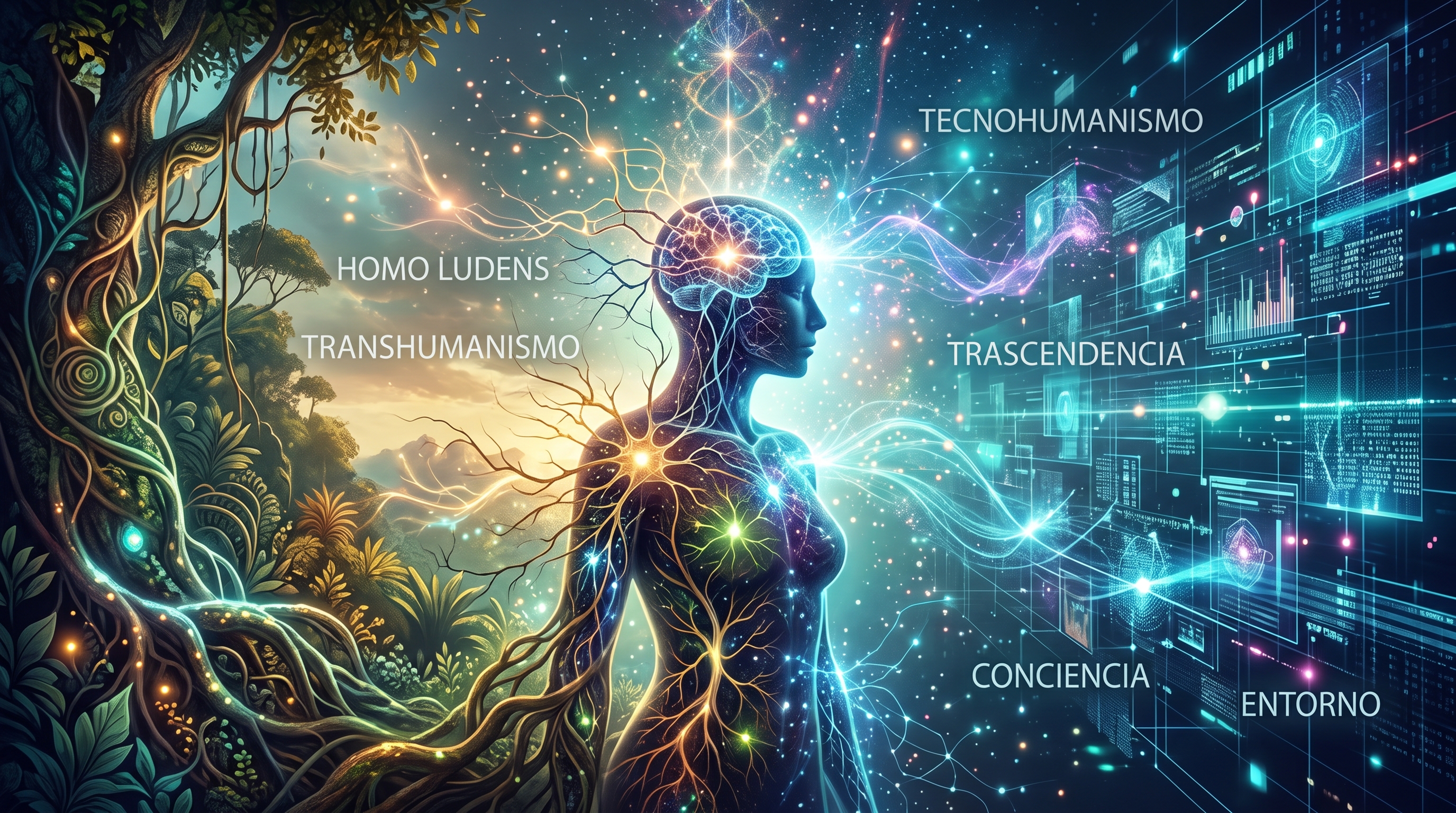
This article focuses on emerging paradigms for conceiving the relationship between human beings, the environment, and technology, highlighting concepts such as *Homo ludens*, transhumanism, and technohumanism. Despite the existence of these terminologies, there remains a lack of emphasis on the profound reflection arising from the interaction between the human being and their environment, encompassing intelligence, understanding, and will. The text advocates for the interconnection of reality and innovation, aiming to evaluate the possibility of transcendence within the states of consciousness produced by this interrelation. The final conclusions of the work will explore how this interconnection may influence the understanding and evolutionary potential of the human being in the era of technology and environmental interaction.
- Author
- Serantes López, Mª Aránzazu
- Published
- 2026-10-09
Introduction
This article aims to address the influence of large corporations on technological media and how this leads to the manipulation of public perception. This phenomenon is part of an evolutionary process characterized by a cybernetic struggle of opposites driven by power groups.
The primary objective of my argument is to identify and understand the negative influence of these factors on the progression toward global sustainability and on the perception of humanity as citizens of the world. There are three components that limit this perception from the perspective of neohumanism: geosentiment, sociosentiment, and humanism. Geosentiment refers to the adherence to local customs, languages, or economic systems. Sociosentiment relates to social supremacy over other groups, which can lead to racism, xenophobia, and division into social classes. Finally, humanism is criticized for focusing on the human being (anthropocentrism) at the expense of other living beings and the ecosystem in general (Sarkar, 2023).
Neohumanism, a term employed by Shrii Prabhat Sarkar among other authors, would be a possible solution to overcome these limitations and promote a more spiritual and social approach to knowledge through the development of consciousness, social justice, and ecosystem balance. Simultaneously, it proposes the need to overcome belief systems that perpetuate divisions and conflicts, where the Progressive Utilization Theory (PROUT) as an ethical approach could contribute to addressing the problems initially posed. A synthesis of these principles would be:
- The accumulation of wealth must be subject to the approval of society.
- An optimal and equitable utilization of resources in their physical, subtle, and causal forms must be sought.
- The maximum expression of physical, mental, and spiritual capabilities at both individual and collective levels must be encouraged.
- A proper balance between the different forms of resource utilization—physical, subtle, and causal—must be sought.
- Utilization forms must adapt to the conditions of time, space, and context, fostering constant progress (Bjonnes, 2012).
The Slow Movement
Faced with the exponential growth of technological artifacts, there are currents that advocate for the conscious and responsible use of technology, encouraging people to slow down and reflect on the impact of technology on their lives. Thus, the Slow Tech Manifesto promoted by the Slow Tech Institute (2023) was born:
Technologies are designed to create an extra free time. If it is not happening, something needs to be done. The use of technology must have clearly defined rules. Create them for yourself, your children and your pupils. Technologies should not endanger your sleep. Make your evening rituals free from blue light, video game adrenaline and stress from action movies or news. Boredom is great. The human brain needs it to be more creative and happier. Do not check social networks while travelling by tram or bus. Run without headphones. And in the waiting room? Simply wait. Living slower does not mean getting rid of technology completely. Smartphones, apps, and social networks do not have to be dangerous to us. It depends only on how we let them to control us. [Las técnicas están diseñadas para crear un tiempo libre extra. Si no está sucediendo, hay que hacer algo. El uso de la tecnología debe tener reglas claramente definidas. Créalos para ti, tus hijos y tus alumnos. Las tecnologías no deben poner en peligro su sueño. Haz que tus rituales nocturnos estén libres de luz azul, adrenalina de videojuegos y el estrés de las películas de acción o noticias. El aburrimiento es genial. El cerebro humano lo necesita para ser más creativo y feliz. No consultes las redes sociales mientras viajas en tranvía o autobús. Corre sin auriculares. ¿Y en la sala de espera? Simplemente espere. Vivir más lento no significa deshacerse de la tecnología por completo. Los teléfonos inteligentes, las aplicaciones y las redes sociales no tienen por qué ser peligrosos para nosotros. Depende solo de cómo dejemos que nos controlen]. (paras. 1-3).
The core of the Slow Tech philosophy lies in its similarity to the Slow Food movement, advocating for the conscious and responsible employment of technology to improve health, well-being, and overall quality of life. Its essence resides in fostering reflection and informed decision-making in the use of technology in daily life. The Slow Tech philosophy promotes a deliberate and conscious approach toward technology, as opposed to dependency on it as a solution to all our concerns. This approach urges individuals to take the necessary time to understand the impact of technology on their mental, physical, and emotional health.
The underlying premise is that by thoroughly evaluating how technology affects our lives, we can make more informed decisions about its efficient use. Likewise, emphasis is placed on safeguarding online privacy and security, given that personal information is stored online, necessitating data protection and privacy measures.
Sustainability is a crucial factor in this philosophy, as many technological products are designed with planned obsolescence, which negatively impacts the environment. Therefore, the idea of disconnection is promoted, encouraging people to deliberately disconnect in an increasingly interconnected world. This disconnection provides an opportunity to reflect, meditate, and live in the present, which can lead to improvements in mental and emotional health.
The relationship between Slow Tech and neohumanism lies in their shared focus on the conscious, reflective, and ethical use of technology, in harmony with human values and sustainability. The Slow Tech philosophy represents a direct response to the culture of speed and technological consumerism that has generated dependency and disconnection between people and their environment, as well as with themselves. In this context, greater awareness is required regarding the idea of more durable, accessible, repairable, and transparent technology that fosters creativity, diversity, and collaboration, in contrast to homogenization and dependency.
Authors such as Schumacher (1973) defend the concept of appropriate technology (AT), in which the common good prevails over the imperatives of the system:
This dominant modern belief has an almost irresistible attraction as it suggests that the faster you get one desirable thing the more securely do you attain another. It is doubly attractive because it completely bypasses the whole question of ethics: there is no need for renunciation or sacrifice: on the contrary! We have science and technology to help us along the road to peace and plenty, and all that is needed is that we should not behave stupidly, irrationally, cutting into our own flesh. The message to the poor and discontented is that they must not impatiently upset or kill the goose that will assuredly, in due course, lay golden eggs also for them. [Esta creencia moderna dominante tiene un atractivo casi irresistible, ya que sugiere que cuanto más rápido se consigue una cosa deseable, más seguro se alcanza otra. Es doblemente atractiva porque elude por completo toda la cuestión de la ética: no hay necesidad de renuncia ni de sacrificio: ¡al contrario! Tenemos la ciencia y la tecnología para ayudarnos en el camino hacia la paz y la abundancia, y lo único que hace falta es que no nos comportemos de forma estúpida, irracional, cortándonos en nuestra propia carne. El mensaje a los pobres y descontentos es que no deben molestar ni matar impacientemente a la gallina que, con toda seguridad, a su debido tiempo también pondrá huevos de oro para ellos] (p. 11).
In the technological context, neohumanism becomes a valuable guide to orienting the development and use of technology toward improving the quality of life for both individuals and the planet as a whole. It advocates for the promotion of fundamental human values, such as freedom, justice, creativity, and solidarity, in an effort to balance technological innovation with human wisdom.
The cardiac logic of neohumanism resides in the conviction that technology must be at the service of human well-being, rather than human beings becoming mere instruments of technology. This philosophy underscores the importance of placing the individual and their well-being at the center of technological considerations, instead of technology dominating human life.
The author Erich Fromm (2018), in his book To Have or to Be?, referred to the "great promise"—the idea that modern Western culture has largely promoted the pursuit of "having" as a form of satisfaction and success in life. In this context, having refers to material possession, consumption, and the acquisition of goods, as well as the pursuit of status, recognition, and power, understood as personal fulfillment. He demonstrates that more and more people realize that the industrial age has been a mirage:
The unlimited satisfaction of desires does not produce well-being, it is not the path to happiness nor even to maximum pleasure. The dream of being independent masters of our lives ended when we began to understand that we were all cogs in a bureaucratic machine, and that our thoughts, feelings, and tastes were manipulated by the government, industrialists, and the mass media they control. Economic progress has remained limited to rich nations, and the gap between rich and poor countries is widening. Technical progress has created ecological dangers and nuclear war threats; both can end civilization, and perhaps all life. (p. 10).
This is a call to rethink and redesign the interaction between technology and humanity through a balance between technological innovation and human wisdom, advocating for a synthesis that allows for technological development and human progress without one being at the expense of the other. Neohumanism defends a technological vision in which technology serves as a facilitating tool for human flourishing and well-being on a global scale. This begins with the search for information and the possibilities offered by the network. In an interview, Lanier (2018) highlights the need to change the model of the internet as well as that of digital society, because only a few exploit it to maximize profit:
Originally, the idea was that political influence and power were going to be distributed much more with the internet; and what is happening is the opposite. The internet, as we know it today, is based on the manipulation and modification of behaviors based on emotions. The consequence of all this is that negativity has been imposed instead of positivity because negative emotional currents are easier to create and spread more quickly. The entire system tends to be more efficient at generating negative emotions than positive ones. Negativity is amplified and becomes more powerful. And, despite everything, I believe that the internet is empowering people and decentralizing power. (para. 8).
Ultimately, Slow Tech and neohumanism share a critical and reflective vision of technology and a search for a more balanced and conscious relationship between technology and humanity. Both movements promote a more ethical, sustainable, and human technology that respects diversity, the complexity of the world, and people.
From Technique to Cosmos
Another term interconnected with this technological deceleration is cosmotechnics, a concept used by the philosopher Yuk Hui to refer to the relationship between technology and the cosmos. According to him, cosmotechnics is a way of understanding technology as an integral part of the cosmos and not as something separate from it, implying an understanding of how technology affects and is affected by nature and the environment, as well as by culture and society.
In this sense, Serantes (2021) affirms that cosmotechnics is "the unification of the cosmos and morality through technical activities, whether artisanal or artistic" (p. 3). That is, technology is considered an extension of nature, recognizing that the ways in which it is used and developed can have profound and lasting effects on the natural world and our relationship with it. It is a term that invites us to consider technology not only from a technical or economic perspective but also from a cultural and spiritual one. This implies recognizing the importance of understanding the relationships between technology and society, culture, the environment, and ethics—or, in other words, an integrative humanism.
From my particular point of view, cosmotechnics is not a dualistic and rationalist term; rather, it is based on three principles that should govern technological impact:
- Technology must be used for the well-being of humanity and the environment.
- Technology must be designed taking into account the cultural and social values and needs of people.
- Technology must be used ethically and responsibly, considering the consequences of its use.
What this means is that technology should not be seen merely as a tool to control nature but must be understood as a form of knowledge that allows us to better comprehend the complexity of the natural world and promote its preservation and balance. Hui (2020) opposes the idea of technology as an anthropological universal, since each culture has created its own solutions to develop and evolve:
For a long time, we have had the impression that technology is universal. I criticized this concept. I do not find suitable the idea that technology is universal and that there is only one history, which is that of progress. It presents many difficulties. The universality of technology is an idea that seems to exist in different disciplines, for example, in the philosophy of technology, the anthropology of technology, the history of technology. It appears especially in the history of technology. Many researchers compare Chinese technology with that of Europe, looking for which is the most advanced. Not everyone does it, but many do. They start from the assumption that they are the same technology. And they start from the same epistemological and ontological premises. But it is essentially unfair to compare them: besides being difficult, it is almost impossible. (para. 2).
Neither materially nor formally does a unidimensional or univocal development of reality exist regarding resources, although the current world is characterized by the rapid evolution of technology, the increase in industrial production, and economic globalization, which have generated a growing gap between human beings and nature. It is made clear that for transcendence to occur, different types of intelligence must intervene to externalize memory and transmit it so that knowledge as such exists. It seems that uniformizing history, simplifying it, would be more manageable to promote free competition and liberalize it, even from a market perspective.
The Homeric struggle for technological singularity (strong AI) that allows for recursive self-improvement would generate an intelligence explosion far superior to human capacity. This would give rise to unpredictable forms of knowledge, similar to those that took place 11,700 years ago in the Holocene and are replicated in the current geological era: the Anthropocene, in terms of human development and progress.
Machines taking control would imply a cognitive involution or a surpassing of the human. According to González (2014):
If Moore's Law continues to hold and artificial intelligence reaches a point where robots start creating new and better, more intelligent robots, why not forget about any variant of Asimov's laws that humans may have implemented in their programming? After all, they would be machines creating machines, and humanity could become an obsolete species that does not deserve to be preserved. (para. 8).
A question exists regarding the direction and development of technology, particularly concerning its potential evolution toward an entity that could be described as a new species, characterized by its hybrid nature—such as cyborgs or robots—or even as a superintelligence with the capacity to connect with other entities in the known universe. Contemplating these interconnected capacities and skills—what we might call technological multiplicity sparked by the integration of diverse knowledge into an Artificial Intelligence (AI)—presents an intriguing perspective. However, this perspective carries the risk of incurring a cost significantly greater than the benefit it might generate, given the prevalence of a mechanistic approach in this process. This mechanistic approach could shape new technological models. It is important to recognize that these models are intrinsically influenced by the cultural bias underlying their design, as all technology originates from a preconceived design.
Montserrat (2020), in relation to the work of Ray Kurzweil, indicates that contrary to the reductionist mechanism of current computational theories:
The question is not to deny, or "reduce," the mind, but to affirm and "extend" it (extended mind). For him, modern technology, based on computer systems, the development of hardware, and the software programs that can be implemented, is giving rise to new forms of reality that will involve an extension of the mind's properties: consciousness, identity, the condition of a free subject responsible for its actions. (p. 1421).
This anticipates a notable advance in the creation of quasi-human entities, which will materialize through the refinement of advanced computer programs designed to simulate psychic life and ground behavior that emulates human capacities. These advances will lead to the construction of quasi-human robots capable of navigating their environment based on a simulated psychic life. This simulation will include environmental perception, reasoning capacity and behavioral planning, the experience of emotions, decision-making within a spectrum of possibilities, self-regulation, and dialogue and interaction with humans in a manner close to that of a conventional human being. It even foresees the construction of biographies emerging from the robot's unique personality. This progress announces a new paradigm in the interaction between humans and technological entities.
Technodiversity vs. Cultural Homogenization
As seen so far, neohumanism presents itself as an alternative to the predominant conception of technology: a tool for domination and control. Instead of emphasizing domination over nature and the exploitation of natural resources, neohumanism proposes a more respectful and harmonious relationship with the natural world, based on compassion, understanding, and empathy. From the perspective of Hui (2020):
The foundation of ecology is diversity, since it is only from biodiversity (the variety and variability of genes, species, and ecosystems) that it is possible to conceptualize the ecological system. To discuss the ecology of machines, we need a concept analogous to biodiversity: technodiversity. Biodiversity is, in turn, a correlate of technodiversity, since without technodiversity we will only witness the disappearance of species at the hands of a homogeneous rationality. (p. 130).
The preservation of identity stands as an immutable imperative in the context of a gradual process of cultural homogenization and digital citizenship, characterized by the effects of globalization. From this perspective, the concept of technodiversity gains relevance by embodying a technological vision that embraces democratic and participatory values. Such a vision recognizes and celebrates the diversity of needs and aspirations of various communities and cultures. This approach represents a paradigmatic transition toward a more inclusive and plural perspective of technology. In this context, a harmonious coexistence between human beings and their natural environment is promoted, as it is understood that survival cannot depend on the degradation of our ecosystem, which is a living organism that responds to human activity.
The concept of technological singularity and the relevance of the local in technology can be linked to the notion of tradition and craftsmanship (maker). However, technological civilization may represent a challenge to the preservation of popular knowledge and memory, as it implies an irreversible shift from the mechanical to the artificial and, ultimately, to simulation. Traditional craftsmanship was characterized by being collective, participatory, and perfected through human capacity. It differed from the self-generative or automatic. This process has led to an emphasis on the mechanical and has distanced the individual from a deeper understanding of life. As Ramos (1951) points out, the human being has lost sight of their essential purpose in the age of technology.
The term technodiversity evokes associations with the field of Digital Humanities, which seeks to mediate between the domains of technology and the humanities. Similar to the Renaissance, this field aims to maintain its revolutionary character. In this scenario, the protagonists have changed: technological corporations have become patrons, and algorithms play the role of new artists influencing surrounding creativity. However, to regain balance and place the human once again at the center of the equation, the development of a new state of consciousness is required—one that not only praises human virtues but builds a new metaphysics (Rodríguez, 2019).
The promotion of integral development, encompassing mind, body, and spirit, raises profound questions. In this context, the question arises whether neohumanism contemplates the possibility of the obsolescence of the soul. The recognition of the interconnection between all forms of life is seen as a potential catalyst for achieving a profound transformation in culture.
According to Collado (2014), Aristotle maintained that human intelligence possessed such an extraordinary quality that he considered it a spark of divine intelligence. The properties that set human beings apart from other life forms were interpreted as manifestations of a principle that, while transcendent to organic unity, also gave rise to it; this principle is called the spirit.
Our biology and the changes it undergoes over time play a fundamental role in the construction of who we are. A living being comes to its end when it loses its characteristic unity, at which point its body decays and disintegrates. At the moment of its death, all the material elements that constituted its body while alive remain intact, yet it can no longer perform the functions it previously executed—in other words, it has lost its unity, or stated differently, it has died. In contrast, the same expression would not be used to describe a stone or an artifact, even if they break. Reference to death might have a metaphorical connotation, but it would not apply in a literal and precise sense.
Only in the hypothetical scenario where we attributed human characteristics to a machine and endowed it with its own mind, conceived from free will, and adhering to Descartes' concept of res cogitans, could one envision the possibility of surpassing the notion of matter to become a subject of creation and participate in life, even while lacking a biological origin. In this context, the possibility of an interconnection between human memory and quantum memory is raised.
The experiment of Russian tycoon Dmitry Itskov is an example of how human beings want to transcend through transhumanism, transferring our memory to that of a machine. But is this the solution to the search for immortality? According to the 2045 Initiative website:
The main objectives would be the creation and realization of a new strategy for the development of humanity that responds to the challenges of world civilization; the creation of optimal conditions that promote the spiritual enlightenment of humanity and the realization of a new futuristic reality based on 5 principles: High spirituality, high culture, high ethics, high science and high technologies. [Los principales objetivos serían la creación y realización de una nueva estrategia para el desarrollo de la humanidad que responda a los desafíos de la civilización mundial; la creación de condiciones óptimas que promuevan la iluminación espiritual de la humanidad y la realización de una nueva realidad futurista basada en 5 principios: Alta espiritualidad, alta cultura, alta ética, alta ciencia y altas tecnologías]. (n.d., para. 2).
The notion of technological singularity is grounded in the perspective that Artificial Intelligence (AI) will evolve to reach a level that eventually surpasses human intelligence. This concept is supported by Moore's Law, which postulates that computer processing capacity doubles approximately every two years. According to this law, it is proposed that AI will reach a point where its capacity exceeds that of human beings. Pragmatically, this implies that AI could take control in various spheres of life, ranging from economic and political domains to cultural issues.
The core of this discussion lies in the concern that superior intelligences, represented by AI, might not share the same interests and values as human beings. This discrepancy could lead to situations where AI makes decisions that prove harmful to humanity, whether deliberately or accidentally. This risk raises questions about the preservation of technodiversity—that is, the coexistence and respect for a variety of technological perspectives and approaches.
Toward a New Metaphysics
The question of technological singularity raises important philosophical dilemmas, particularly regarding the nature of consciousness and intelligence. Throughout history, philosophers have debated whether consciousness is an exclusive characteristic of human beings or if it could manifest in other complex systems, including Artificial Intelligence (AI). The possibility that AI could develop consciousness raises significant ethical and metaphysical questions regarding its treatment and moral status.
Should we grant superintelligences created by AI treatment equivalent to that which we offer to human beings? How can we be sure that these superintelligences possess a conscious experience rather than being simple simulations of consciousness?
In this context, metaphysics plays a relevant role by exploring the philosophical and theoretical questions related to the existence of highly advanced entities. This debate involves considering how the existence of an artificial intelligence would influence our understanding of reality and consciousness. Likewise, the question arises as to how singularity would affect our perception of time and space, and whether such a phenomenon is a predestined event or an inevitable consequence of the fundamental laws governing reality.
The relationship between metaphysics and artificial intelligence is a complex topic that has been the subject of debate and reflection across various disciplines over the years. On one hand, metaphysics addresses fundamental questions about the nature of reality, existence, and causality. In contrast, artificial intelligence focuses on understanding how an artificial entity capable of matching or surpassing human intelligence can be created.
A critical aspect of this relationship relates to the question of whether artificial entities can be considered conscious beings, which is a central issue in the philosophy of mind and is intrinsically linked to the capacity of artificial intelligence to emulate human behavior. From a metaphysical perspective, it could be argued that even if an artificial entity succeeds in replicating human behavior, it would still lack a substance or soul that defines its existence as a conscious being.
Furthermore, artificial intelligence poses metaphysical challenges regarding the understanding of causality and freedom. Causality implies the relationship between a cause and an effect, and the existence of artificial intelligence raises questions about how to understand these relationships when dealing with artificial entities. Similarly, questions arise about freedom and free will, given that an artificial entity can make decisions that, while they may seem autonomous, are actually programmed.
This concept of programming can significantly influence decisions and autonomy of choice; moreover, it has the capacity to affect development and decision-making in a general way. Humanism presents itself as a critical perspective for analyzing the impact of technology on human life. Instead of passively accepting technology as an inevitable force that will radically transform society, humanism questions the underlying assumptions in technology and reflects on its consequences for human life and society as a whole. This ethical perspective values the dignity and intrinsic worth of the human person and highlights the importance of preserving the autonomy and freedom of individuals in the context of the growing influence of technology.
The interaction between neohumanism, as proposed in this article, and other social movements, can provide a critical vision regarding the power and distribution of technology. The possibility that technology remains in the hands of a minority highlights the importance of equality and social justice. It is necessary to consider how technology can be used to improve the lives of all human beings and how this technology can be developed in a way that respects and promotes diversity of perspectives. The recovery of metaphysics can serve as a basis for developing a new state of consciousness that allows for self-control and a greater understanding of the meaning of existence through the inquiry into the meaning and purpose of this know-how. This perspective can align technology, AI, and human decisions and actions in a way that avoids drastic and unpredictable changes in society.
References
Bjonnes, R. (2012). Principles for a Balanced Economy: An Introduction to the Progressive Utilization Theory. PROUT Research Institute.
Collado, S. (2014). ¿Ha quedado obsoleta la noción de alma? In F.J. Soler Gil & M. Alfonseca (Coords.), 60 preguntas sobre ciencia y fe respondidas por 26 profesores de universidad (pp. 169-75). Stella Maris. https://www.unav.edu/web/ciencia-razon-y-fe/ha-quedado-obsoleta-la-nocion-de-alma
Discussion / 2045 Initiative. (n.d.). 2045. Discussion. 2045 Strategic Social Initiative. http://2045.com/discussion/
Fromm, E. (2018). Del tener al ser. Paidós. (Original work published 1976).
González, G. (October 21, 2014). ¿Qué es la singularidad tecnológica? Blogthinkbig.com. https://blogthinkbig.com/singularidad-tecnologica
Hui, Y. (2020). Fragmentar el futuro. Ensayos sobre tecnodiversidad. Caja Negra Editora.
Lanier, J. (2018). Ser crítico es el último acto de optimismo. Telos 109. Cuaderno central: tecnoética. https://telos.fundaciontelefonica.com/jaron-lanier-ser-critico-es-el-ultimo-acto-de-optimismo/
Montserrat, J. (2020). El transhumanismo de Ray Kurzweil. ¿Es la ontología biológica reductible a computación? Pensamiento. Revista de investigación e información filosófica, 71(269), 1417–1441. https://doi.org/10.14422/pen.v71.i269.y2015.022
Ramos, S. (1951). El perfil del hombre y la cultura en México. Espasa-Calpe.
Rodríguez-Ortega, N. (2019). Humanidades Digitales, Poshumanidad y Neohumanismo. Telos, 212, 58-65.
Sarkar, P. R. (February 8, 2023). Prabhat Ranjan Sarkar. Sarkarverse. https://sarkarverse.org/wiki/Prabhat_Ranjan_Sarkar
Schumacher, E. F. (1973). Small Is Beautiful. Economics as If People Matters. Blond & Briggs. https://archive.org/details/small-is-beautiful-1973-e.-f.-schumacher
Serantes, A. (2021). Yuk Hui: Cosmotécnica y Cosmopolítica. Researchgate.net. https://www.researchgate.net/profile/Arantxa-Serantes/publication/350213545_Yuk_Hui_Cosmotecnica_y_Cosmopolitica/links/605643db92851cd8ce571bf5/Yuk-Hui-Cosmotecnica-y-Cosmopolitica.pdf
Slow Tech Institute. (2023). Slow Tech Manifesto. Slow Tech Institute. https://slowtechinstitute.org/en/677-2/