Apps para la reconstrucción virtual del patrimonio
Javier Ordoño of Arkikus explains how mobile apps are revolutionizing the heritage experience, bringing virtual reconstruction to the visitor's pocket.
- Interviewee
- Javier Ordoño · CEO & Co-founder ARKIKUS - Arqueólogo - Virtualización del Patrimonio, Nuevas Tecnologías, Turismo cultural · ARKIKUS
- Category
- Tecnología creativa y difusión digital
- Published
- 2023-03-13
Interview with Javier Ordoño of Arkikus.
Pedro Ortega: The main solutions you propose at Arkikus for the virtual reconstruction of heritage are Apps, although you also use web applications. How did you conclude that this was a good way to show past heritage?
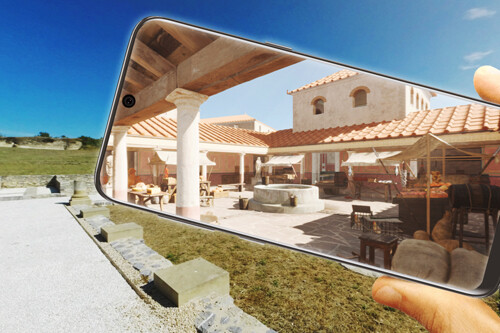
Javier Ordoño: We have always been clear that heritage must be made known to the general public, so access must be facilitated as much as possible. Mobile apps or web apps allow visitors to carry the tool for enjoying heritage in their own pocket, within widely used devices such as smartphones and tablets, so they do not depend on additional external instruments such as brochures, guides, interactive screens, VR glasses, etc. This does not mean that the experience cannot be complemented with these other instruments, simply that it is not necessary to do so. The advantages are obvious for the visitor: they are the ones who manage and decide how to use the tool, according to their choice; they can take it home to continue enjoying it once the visit is over; apps constitute a flexible, multi-content, and expandable tool at all times, which can be adapted to very diverse audiences (including young people, who can be brought closer to heritage through their interest in apps and new technologies) and is open to continuous innovation. But it also has advantages for the manager of the heritage asset: they do not have to invest in proprietary devices that sometimes have a high cost and difficult maintenance (e.g., VR glasses) or even an environmental or heritage impact (physical installations in situ) or that do not offer as many possibilities (audioguides); the contents, being all digital, can be reviewed and improved at any time, so they do not have to be remade (e.g., brochures); furthermore, it offers direct feedback on the visitor experience. In short, we firmly believe that the use of mobile apps or web apps is the best way to disseminate heritage in a flexible, sustainable, and innovative way.
PO: I believe you also contemplate the possibility that your Apps can be used with virtual reality glasses. How do you see the present and near future of this technology? Will we soon be able to enjoy XR glasses at a reasonable price and with a single standard?
JO: Although, as I said, we have always bet on the use of personal mobile devices like smartphones or tablets, our apps can indeed be integrated into virtual reality glasses. In fact, all our apps have two navigation modes: touch and VR. The second can be used both by placing the smartphone in viewers with special lenses for virtual reality and by integrating the app into VR glasses like Oculus. Although it is true that the latter offer a more immersive experience and better image quality, it must be said that they are currently designed more for personal use at home (e.g., for playing video games) or at least in indoor and well-controlled environments. In the field of heritage dissemination, at least outside museums, they currently pose more drawbacks than solutions (devices break easily—sunlight, drops—or run out of battery, they must be shared and, therefore, sanitized between visits, they should only be used in well-controlled spots without obstacles for visitors, the experiences sometimes produce motion sickness, it takes time for the visitor to internalize the use of the controls, ...). We hope these drawbacks will be solved in the future as VR/XR glasses manufacturers think more about outdoor experiences like those posed by heritage dissemination. An essential aspect will be the design of devices with resistant and lightweight materials and viewers that allow a gradual visual transition between current reality and virtual reality or the superimposition over the former of an augmented reality with much higher visual quality and spatial precision than what is supported today. We find it difficult in the short term to access these devices at reasonable prices, as we observe that the main sellers of VR glasses, instead of bringing mid-range devices to market or continuing to sell previous versions at lower prices, opt to sell new versions with slight improvements and increasingly higher prices, which clearly does not favor their spread among the public. Few people who are not very interested in video games or the metaverse buy a VR device. However, everyone (or almost everyone) already has a smartphone in their life.
PO: What is the procedure you follow when approaching a heritage virtualization project?
JO: Actually, we take care of the entire process. After contacting the client or collaborator, we begin working on the existing documentation about the heritage asset to be reconstructed, conducting an exhaustive documentary sweep (historical documentation, scientific publications, archaeological reports) in collaboration with local experts (or motu proprio, when this is not possible). At the same time, we document the heritage environment graphically and geometrically (scanning, photogrammetry), obtaining a digital twin over which, starting from the documentary analysis, we will later raise our virtual scenarios using different 3D modeling, rendering, and graphic post-processing software. These digital contents are then integrated into 360º interactive scenes that, together with complementary content such as texts, audios, drawings, photographs, videos, games, etc., form the basis of the mobile or web apps. Finally, the apps are uploaded to the corresponding stores (Google Play for Android or App Store for iOS) or servers (in the case of web-apps) so they are available to visitors. Occasionally, we also handle designing and executing the signage associated with the use of the app (advertising banners, totems with maps and download information, signaling of points of interest).
PO: Many of your applications show virtualized heritage with 360º photographs. What technologies do you use to create these images?
JO: Yes, to offer the best graphic quality according to the power of current smartphones, we resort to 360º virtual environments of the current state and the reconstructed past. For this, we use different techniques for obtaining and generating them, always seeking a minimum quality of 6K (later adaptable to the resolution of each device).
Regarding the acquisition of 360º views of current physical reality, we use different equipment and processes according to the typology of the view—it is not the same if it is an interior or an exterior, an accessible place or not, at eye level or aerial... Depending on each case, we are working with drones, common SLR cameras with image post-processing, and specialized equipment such as 360º cameras (photo and video) or 3D scanning equipment and/or virtual tour capture (e.g., Matterport, Leica BLK360...).
Finally, for the execution of the 360º views of the virtually reconstructed environment, we resort to rendering software that allows exporting these 3D environments in different formats and qualities, including 360º images and videos.
PO: Unlike some programs used for heritage reconstruction, the solution you use gives a result that is indistinguishable from reality. What kind of rendering do you use to achieve these hyper-realistic finishes?
JO: This is a very interesting question because the answer could expire in a very short time; the world of rendering is evolving at an incredible speed and one must always be open to constant renewal. Throughout our trajectory, we have worked with different texturing, lighting, and rendering programs and with the two main technologies for generating images (Rasterization and Ray Tracing). But at this precise moment, thanks to the technological leap offered by RTX graphics cards, we work in parallel with two programs that are bringing much innovation to the industry: Unreal Engine and Twinmotion (both from the Epic Games universe).
Beyond that, it is necessary to indicate that no matter how much the quality and precision of these programs' simulation calculations improve, the human component that develops the environments, textures, and lighting configuration must always be valued. As a very graphic simile, we could say that rendering programs are to the virtualizer what the brush and paint (the material we use) are to the painter: in both cases, the final result will depend largely on the knowledge of proportions and experience in applying the different techniques of the person.
PO: I believe you also use geographic information systems to superimpose virtualized heritage and reality. How is this procedure done?
JO: Spatial precision is an essential requirement to ensure the hyper-realism of our reconstructions. That is why we use digital maps (raster, vector) or digitized maps (e.g., historical maps), CAD files, or digital elevation models of heritage environments to "place on the board" all current and past constructive evidence and make them fit perfectly within the scenarios we show the public. We do not build reconstructions on ethereal virtual environments; we do it on a well-documented geographical and geometric base.
PO: Another important element in your Apps is gamification. To what extent is play important in your applications? What objectives do you achieve with it?
JO: Gamification is becoming increasingly important in our work. It must be understood that heritage dissemination, in addition to having a rigorous scientific basis and a didactic component, must also be stimulating and, to a certain extent, fun. Only in this way will we reach all audiences. This does not mean that in our work we will prioritize gamification over teaching heritage. We simply give the visitor the option to choose between a purely academic enjoyment or a more gamified one, safeguarding documentary quality and fidelity in both cases. We are very clear that we cannot deliver information in the same way to an expert as to a child. Gamification allows, among other advantages: bringing heritage closer to younger audiences while enhancing group enjoyment (e.g., families), maintaining interest in the visit for longer (by posing challenges to solve that serve as a hook), offering a final incentive (e.g., a gift for completing the game), and introducing different ways of interacting with heritage information (posing historical impossibilities, playing with the spatiality of elements, etc.). In short, we believe that gamification, properly planned, is a plus and only brings positive aspects to heritage dissemination.
PO: Which App are you most proud of? Can we download it and see it even remotely?
JO: The truth is that it is difficult to choose one of our apps. They have all left a mark in one way or another on the team, as they are very different projects and, in some cases, have sentimental proximity. From the first app we executed back in 2018 at the Convent of Santa Catalina de Badaya, a finalist for best tourist app at Fitur 2019, which was one of the first boosts for the Arkikus project, to the Castillo de San Vicente de la Sonsierra App, Hispania Nostra Award 2020, which was a great incentive, to our latest app, Enkarterri Virtual (2022), the most ambitious of all as it includes a novel game dynamic. We have more than a dozen apps and they all contribute something new, not only in terms of historical scenarios and reconstructions but also in terms of functionalities and improvements that have been progressively added (real people dressed in period costumes in motion, sharing function on social media, game mode...). The vast majority are free to download or view on Google Play and App Store (by typing "Arkikus" in their search engines) or on their respective websites (links available on our website www.arkikus.com). Additionally, it should be said that they are all part of the exclusive list of scientific-based tourism experiences ("Turismo con Ciencia") of the Fundación Descubre (https://turismoconciencia.fundaciondescubre.es/) and are examples of good practices in the Smart Tourist Destinations Network. As the number of apps continues to grow at a magnificent rate, our goal is to create a national (and in the future international) network of heritage sites with virtual reconstruction experiences with the Arkikus seal or other high-quality initiatives that combine heritage + technology—an "Arklink" that generates interest and publicity among them so that the heritage tourist can design recurring visit plans using new technologies as a common thread. Right now, we are working on a platform to visualize this network.
PO: I end my interviews with the same question: do you see it feasible to create a metaverse that gathers virtual heritage and whose use is free?
JO: Honestly, we believe there is still a long way to go for that to be a reality and, even if it were, we are a bit skeptical about its success (not only of a heritage metaverse but of other types of metaverses). Really, nothing beats the experience of visiting heritage in situ (and in general, any corner of the world) and, while a heritage metaverse can have its utility in certain contexts (educational, people with functional diversity), we believe its success will be temporary or very situational. Only experiences that combine the real (the authentic) and the virtual have enough strength to remain in people's memory and, therefore, in time.
PO: Is there anything else you would like to add?
JO: We would simply like to thank you, Pedro, for your interest in our project. We hope the interview is to the liking of your loyal readers (including ourselves) and we would be delighted to participate again whenever you deem it appropriate.
Thank you very much for your time.