Documentación digital del Patrimonio Mundial
Enrique Sanz from ConArquitectura explains the organization of the documentation for the nomination of the Paisaje de la Luz as a UNESCO World Heritage site.
- Interviewee
- Enrique Sanz · Director Editorial en conarquitectura ediciones s.l. · conarquitectura ediciones s.l., ETSAM
- Category
- Museos, instituciones y gestión cultural
- Published
- 2023-03-27
Interview with Enrique Sanz from ConArquitectura.
Pedro Ortega: When the possibility of preparing the Paisaje de la Luz nomination for inclusion on the World Heritage list arose, how did you plan the organization of the documentation?
Enrique Sanz: In these types of projects, where a significant amount of information must be organized before knowing exactly what will be told, we encounter some obstacles to making the work flow smoothly. Much of the material that accumulates is redundant and is later not used. One could say that "the trees don't let you see the forest." Therefore, it is essential to start with a good index of the final document's content, agreed upon with authors/coordinators, and to classify the raw material according to the objective of the publication. Since our skills as editors are not those of an archivist, for each project we invest time at the beginning thinking about which specific working method best suits that particular case.
PO: How is the information you have collected about the Paisaje de la Luz structured? How can this information be archived in a municipal repository like the memoriademadrid Digital Library?
ES: Although the registration was set in motion in 2014 under Mayor Ana Botella, in 2018 the candidacy was reformulated to be presented to the National World Heritage Commission. There, the State, after a vote with representatives from the Autonomous Communities, assumed the Madrid proposal to present it as a candidate for the UNESCO World Heritage list. The participation of conarquitectura ediciones, as managers of the documentation, began at that moment, alongside Mónica Luengo (the general coordinator of the dossier) and Carmen Rojas (Coordinator of Culture, Sports, and Tourism of the Madrid City Council). The development of the dossier for the registration of the property has been a labor of years, divided into successive stages, which are explained in this summary table:
We have organized the documentation chronologically for each of these phases. There have been numerous revisions from one phase of the document to the next, and the different versions were deposited in the Archivo de Villa whenever a document was prepared to be presented to UNESCO. On the other hand, I believe that uploading all this information (the development of the complete dossier) to the memoriademadrid Digital Library is an enormous task that would serve as a record of a complex process, but ultimately it would be unclear for a visitor to that website for the dissemination of Madrid's historical heritage. I would be satisfied with there being a version of the approved dossier with the latest modifications, which would already require a certain amount of editing to improve comprehension.
PO: What programs have you used to catalog all the information gathered throughout the development of the candidacy and the subsequent inclusion?
ES: To organize the images, we used Adobe Bridge, which allows us to tag and reorder images, assessing their relevance for one use or another. But above all, we started with a good folder design in Dropbox, adapted to the structure of the work. We work in the cloud (also on the studio's local network) as it is convenient for us to have a search engine in shared folders available at any time.
PO: Two years ago we shared the experience of the Wikipedia workshops. What is your opinion of this project and its utility as a cataloging element, in this case, for the Paisaje de la Luz?
ES: Fundamental. I think Patricia Horrillo does an impressive job spreading knowledge about editing on Wikipedia, which has fit perfectly with what the Paisaje de la Luz needed to improve public awareness. The figures of what has been achieved in these two years are striking, and the best part is that we can still go further: the Paisaje de la Luz is very deep and we can all lend a hand in improving knowledge of it.
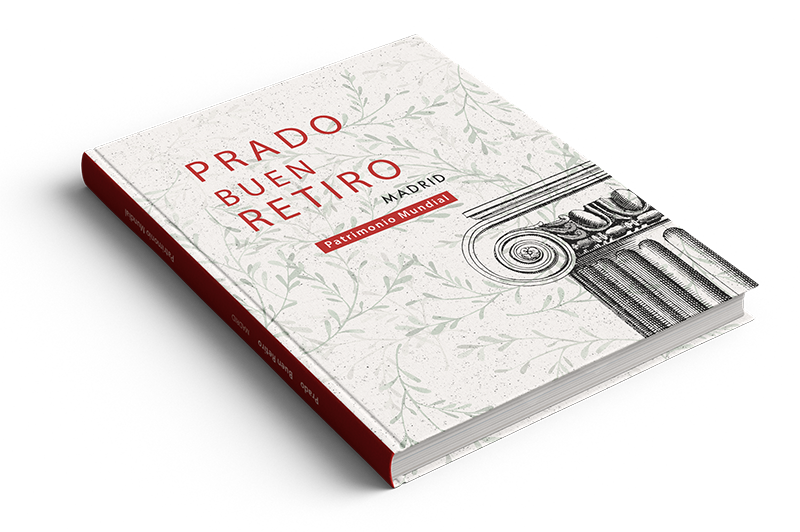
PO: Much of the material from these archives has been included in the publication «PRADO BUEN RETIRO, Madrid. Patrimonio Mundial». Where can we find it?
ES: This book has been a work by conarquitectura ediciones, featuring collaborations from some of the experts involved in the preparation of the nomination dossier. We set out to prepare this ambitious book because we wanted to see a manageable summary of the spectacular set of information that had been poured into the dossier. Although everyone knows the Paseo del Prado and the Buen Retiro, we felt it was appropriate to bring certain data together in a publication and almost congratulate ourselves for having obtained this universal recognition. As has been said in some campaigns, now the Prado and El Retiro are not "ours," they belong to all of humanity. The book—forgive me, this sounds like a commercial, but you asked—can be found in all bookstores specializing in Art and architecture, and in general retailers like Casa del Libro, Fnac, El Corte Inglés… it has had a fantastic impact, and we would like to publish a bilingual edition soon.
PO: I want to take this opportunity to ask you about the work of ConArquitectura. I know you run a prestigious architecture magazine and that you have produced several catalogs, such as the one for the Piranesi exhibition at the National Library. What are your main medium-term projects?
ES: Indeed, we move across almost all ranges of editorial activity for the dissemination of architecture and heritage. I would recently highlight a book we helped shape, co-published by the Madrid City Council and the COAM Cultural Foundation on cartographies of the history of Madrid; from 1530 to the present day; an exciting review of the city's image in maps, engravings, and paintings, which will be of great use to researchers and enthusiasts of Madrid in general, authored by Javier Ortega and Francisco Marín Perellón. This year we hope to publish two books on recently restored or rehabilitated architecture (the Hexagons Pavilion by Corrales and Molezún, restored by Carmen Rojas and Justo Benito, and an intervention by Carlos de Riaño at the German School). We are also preparing a guide to contemporary Madrid architecture for the fall, which we are planning with great enthusiasm, and about which I don't want to reveal more details yet. I think it will be something never seen before.
PO: One of the questions I ask at the end of these interviews has to do with the Metaverse. From your point of view, do you think it is viable to create a virtual space where we can access reconstructions of cultural heritage? Do you think this project could be viable for free, like a 3D Wikipedia?
ES: I follow your blog and newsletters with these interviews with interest, and I am seeing a generalized interest in this "cultural Metaverse" but a certain skepticism about its implementation in the short term. Personally, I would tell you it is the only Metaverse that interests me (not the commercial, recreational, or personal interaction one—perhaps I'm too old for that) and that it is urgent that it be launched. I encourage you to keep searching for the actors and entities that can be involved in shaping it as soon as possible. That it be global, free, and collaborative, like Wikipedia, is fundamental. You will have all my support and collaboration. I am sure we will be starting in a few months.
PO: Would you like to add anything else?
ES: Just that it has been a pleasure to participate in this initiative, although my contribution to the editorial line of these interviews on digital heritage has been a bit tangential. Although I am interested in everything related to ICT, I am more of a paper person.
Thank you very much, Enrique.