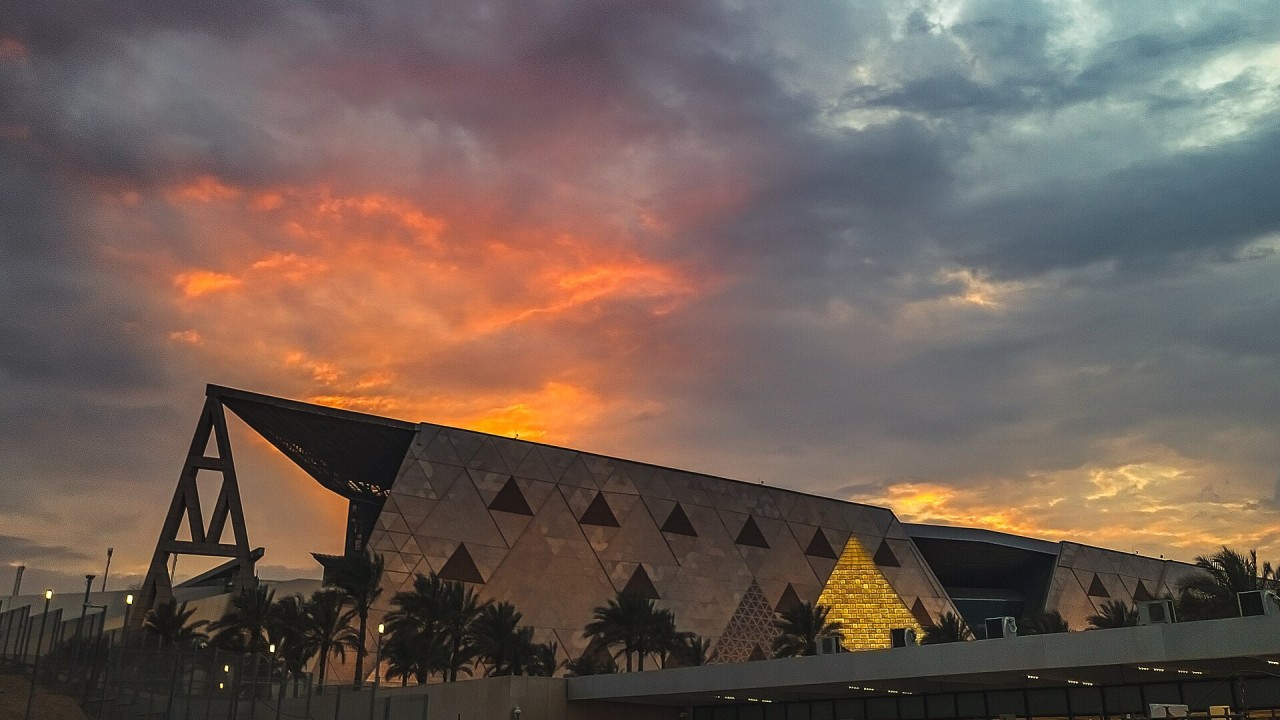
En el corazón del Gran Museo Egipcio
- Interviewee
- Enas Mohammed · Conservadora · Gran Museo Egipcio
- Category
- Museos, instituciones y gestión cultural
- Published
- 2026-05-30
Pedro Ortega: As a researcher and museum professional, how does your personal relationship with your native culture manifest in your daily work at the Grand Egyptian Museum?
Enas Mohamed: My relationship with my native culture is not abstract: it is deeply personal and vivid. As an Egyptian conservator working at the Grand Egyptian Museum, I feel that I am not just preserving objects, but safeguarding fragments of collective memory. Every textile fiber, manuscript page, or organic artifact I examine represents part of a long and continuous cultural narrative to which I belong. This connection influences my daily decisions: I approach each object with respect for its historical, spiritual, and social dimensions, not just its material state. My work is not merely technical; it is an act of responsibility toward past and future generations.
PO: From your position at the Grand Egyptian Museum, what decisions or processes do you consider to have contributed most to its intellectual creation?
EM: My most significant contribution lies in the documentation methodology and preventive conservation strategies, especially for organic materials. Through scientific documentation—microscopy, high-resolution photography, and condition mapping—I contribute to building a reliable knowledge base for the collections. I have also worked on developing mounting solutions for exhibition that respect both material stability and interpretive clarity. In this vein, conservation is integrated into the museum's intellectual narrative: the way an object is mounted, presented, and contextualized directly determines how the object is understood.
PO: When we talk about the creation of the Grand Egyptian Museum, what exactly does the idea of “creating” a museum to house an entire great culture mean to you? Where do you believe the core of this creation resides?
EM: Creating a museum of this scale goes far beyond building a structure. For me, it means reorganizing knowledge, redefining standards, and building a narrative that connects the past with the present. The core of this creation resides in balancing authenticity with accessibility. It is about establishing museological and conservation standards that are scientifically rigorous and, at the same time, emotionally significant for a global audience. The museum becomes a space where research, preservation, storytelling, and public participation converge.
PO: I wanted to ask you about the Fayum portraits. Are you currently working with them, or have you done so at some point? If so, from what perspective have you approached them?
EM: The Fayum mummy portraits occupy a unique place in Egyptian heritage. Although my primary specialization is organic materials—textiles, manuscripts, and leather—my work is linked to conservation and documentation challenges similar to those posed by objects like the Fayum portraits, especially regarding preventive conservation, environmental control, and exhibition strategies. When I work with comparable mixed objects, I approach them mainly from a conservation and documentation perspective, focusing on stability, environmental sensitivity, and long-term preservation planning.
PO: Regarding the Fayum portraits, what interests you most today? What challenges do they pose for their exhibition and interpretation in a contemporary museum?
EM: What interests me most is their powerful confluence of individuality and ritual. Their visual language feels strikingly contemporary, yet it is inscribed in a deep funerary and spiritual context. The main challenges are light sensitivity, environmental control, and interpretive framing. Exhibiting them requires balancing their aesthetic appeal with their funerary significance. In a contemporary museum, we must avoid presenting them simply as “beautiful paintings”; it is necessary to contextualize them within the framework of identity, belief systems, and intercultural exchange in Roman Egypt.
PO: In the cataloging and documentation of collections, what system do you use and what methodology do you follow?
EM: In documentation, we use structured museum databases integrated with conservation status recording systems. The methodology employed combines detailed visual examination, digital microscopy, high-resolution photography, material identification records, condition mapping, and risk assessment. The approach is systematic and research-oriented, so that documentation supports both conservation decisions and academic study.
PO: Do you use 3D scanning or photogrammetry technology in your work? For what purposes, and what limits or precautions do you consider key?
EM: Yes, 3D scanning and photogrammetry are increasingly valuable tools. They are used for condition documentation, virtual exhibition and accessibility, research and measurement taking, mount design planning, and documentation for risk management. However, precautions are indispensable. Exposure to light, handling risks, and data management protocols must be rigorously controlled. Digital documentation should complement the direct study of materials, not replace it.
PO: What role does artificial intelligence play, or could it play, in your work? And how do you imagine the development of Digital Humanities in the future of cultural disciplines?
EM: Artificial intelligence has considerable potential in metadata enrichment, pattern reconstruction, image comparison, and large-scale archival analysis. It can improve accessibility through multilingual catalogs and automated tagging. However, AI must remain a tool guided by expert conservation curatorship. The future of Digital Humanities lies in integrating technology with critical interpretation: using AI to expand access and research possibilities without losing contextual depth or ethical responsibility.
PO: To conclude, is there any topic, project, or reflection you would like to add to this interview?
EM: I am especially interested in the integration of ecologically-based scientific documentation into museum practices. Sustainable conservation strategies, such as reducing material waste, improving environmental efficiency, and responsibly digitizing documentation, are central to the future of heritage preservation. Today's museums must not only preserve the past but also act with responsibility toward the future.
PO: Thank you very much for your time