En torno a Ventanas al pasado
Pablo Aparicio Resco, art historian and specialist in heritage virtualization (3D Stoa, PAR), talks about his book "Ventanas al pasado", the scale of evidence in 3D reconstructions, and the risks of generative AI in historical recreation.
- Interviewee
- Pablo Aparicio Resco · Historiador del arte, arqueólogo y especialista en virtualización del patrimonio · 3D Stoa – Patrimonio y Tecnología / PAR – Arqueología y Patrimonio Virtual
- Category
- Reconstrucción virtual e inmersión
- Published
- 2026-01-23
A conversation with Pablo Aparicio Resco
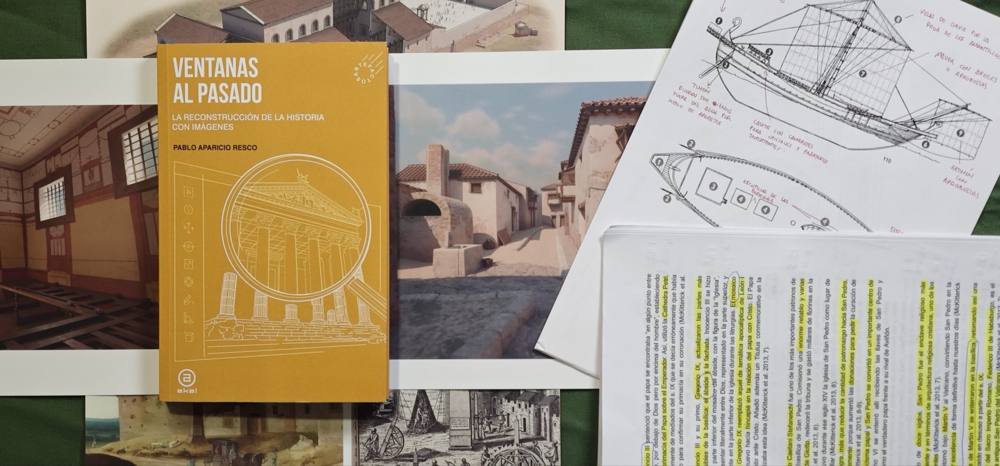
Pedro Ortega: First of all, I wanted to congratulate you on this book, which I consider necessary and brave, especially for your commitment to historical truth in visual reconstructions. I wanted to ask you how the idea of writing this book came about and who your main influences have been. Pablo Aparicio: First of all, of course, thank you for valuing the book so generously. It is a work that I had been wanting to carry out for more than a decade, especially after realizing that there were no essays that broadly addressed the origins and evolution throughout history of the design of reconstructive images of our past. On this path I have drawn from many scholars but, fundamentally, I would highlight the work of the Italian Giuliano De Felice at the Roman villa of Faragola, which I talk about in the book, and the reflections of a fellow illustrator, Iñaki Diéguez. They helped me realize that there was still much to be told in this story. PO: So that we know the degree of veracity of a 3D restoration, you talk in the book about the use of a color code. This traceability is the fundamental tool so that historians can modify the reconstructions in case new historical evidence is found. Although it is a clear method in its definition, I don't know if it is easy to apply in reality. What can you tell me about this? PA: There are several tools that allow us to visually show the level of evidence of a virtual reconstruction. The scale of evidence is one of them, perhaps one of the most widespread. It allows us to indicate, in warmer tones the areas with greater evidence and in colder tones those with less evidence. It is very useful and simple to use but requires a period of reflection and technical design work that cannot be underestimated. In short, its application is very simple and very useful for research and general dissemination, but I think it still needs to be spread further so that it is taken into account in the commissions that are carried out and, therefore, its implementation becomes viable in terms of time and costs. That being the case, it could be implemented without problems in most virtual reconstruction work. PO: One of the axes of the book is the reconstruction of the Constantinian Basilica of St. Peter, probably one of the most emblematic buildings of Antiquity, although it has been eclipsed by the current Vatican Basilica. How can we bring knowledge of this and other such important buildings of Antiquity to the general public? PA: Indeed, in chapter 7 of the book I address the process of creating a virtual reconstruction guided by the case of the old St. Peter's Basilica in the Vatican. I give great importance to how different historical-archaeological sources allow us to complete the puzzle of history and, in that way, be able to carry out a virtual reconstruction in a precise, almost surgical way. Archaeological remains, paintings, engravings, texts, etc., help us to have all the information and, with it, be able to shape our virtual reconstruction work. The most important thing is, therefore, the control we have over the process to ensure that everything we know about the building is reflected in these artistic-technical works that are virtual reconstructions. PO: You have created recreations of various cities of the past, such as the case of Elephantine, which you told us about in Humanismo Digital #1, of Segóbriga, as well as other Roman cities in Catalonia. As far as I know, we can only see different static images of these enclaves; haven't you thought about being able to make them available to the public on a platform to navigate in 3D? PA: It is a very good question because it allows us to talk about the technical possibilities and limitations of this type of tool. Of course, I could develop a 3D viewer or an interactive virtual tour of any of these cities—Roman Segóbriga or Egyptian Elephantine—but the adaptation to an interactive environment of a reconstruction made to be represented in static views takes a lot of work, time and, therefore, added costs. In the book I explain, therefore, that the first thing we must take into account when designing a virtual reconstruction is the use that is intended for it, since different paths will be followed depending on what type of result we want to achieve (static views, 3D animation, 360º views, virtual or augmented reality experiences, etc.). PO: In one of the chapters you talk about the model by León Gil de Palacio, the model of Madrid in the 19th century that you have also scanned for the Museum of History of the Madrid City Council. What uses do you think can be given to this model once digitized? PA: The model of Madrid designed by Gil de Palacio is one of those rare examples of pre-technological three-dimensional documentation that have reached us. Its photogrammetric documentation has allowed us to have its digital twin, both complete and in fragments, as we were able to digitize it during its restoration process, which required its disassembly. This guarantees its digital conservation, which will be an important aid for future restorations, but it will also facilitate its digital accessibility—for example, through Sketchfab 3D viewers—taking measurements, obtaining orthophotos or sections, etc. Furthermore, we are currently also testing 3D Gaussian Splatting technology to allow for a more suggestive and lighter visualization from any device. PO: You talk about the use of artificial intelligence in the recreation of images of the past. I agree with you that they create plausible images but lacking in historical rigor. Unfortunately, no regulation is going to prevent generative AI (GenIA) from being used for the creation of "historicist" recreations, so we are only left with the pedagogical option, that of preaching the truth in a world of fakes. Do you agree with me? What do you think we can do about it? PA: Indeed, we live in a world in which artificial intelligence is permeating everything and we must adapt to living with it. I think that at this point it is important, on the one hand, to understand that not all AI is generative and that there are many tools and projects that use AI of different types without generating text, sound or images and, on the other hand, we must understand that GenIA should only be used—in any case—as a tool and not as an end in itself. In this sense, of course, a lot of pedagogy is needed not only about the historical fakes that can be created with great ease thanks to generative AI but also, for example, about the environmental problems that this technology helps to intensify. PO: You are an advanced Blender user in its full extent. Speaking again of AI, I wanted to ask you about the iCity plugin for Blender. I don't know if you have used it and if you think it could be useful for creating, for example, secondary buildings of a city from the past, giving it the appropriate assets on which it must be based. PA: Blender is free software that, fortunately, has addons like the one you mention, iCity, created by the software community, and which allow you to do fascinating things that are not possible with the basic program—in this case, for example, the semi-automatic creation of a modern city. I work with many addons of this type that undoubtedly facilitate day-to-day work. In the specific case of iCity, the technology it uses is geometry nodes, which is not AI as such but an advanced procedural 3D design system. Of course, a system for designing Roman cities—or any other culture or chronology—could be generated based on geometry nodes that, in a semi-automatic way, would allow creating streets, blocks, etc. It is, however, a very advanced and complex job that requires years of development and very broad technical knowledge in this tool. I would love to be able to dedicate time to it at some point, perhaps in collaboration with other Blender experts. PO: I missed you addressing virtual and augmented reality in your essay. You talk about it in that magnificent letter to the future that is your epilogue. In my humble opinion, I think that 3D reconstructions of places from the past flood our museums, both on screens and with devices like 3D glasses. However, the reconstructive criteria vary greatly from one reconstruction to another. There are no standards. I have the dream of seeing a platform to locate virtual reconstructions of the past both geographically and temporally. But I think there is a lack of will, budget and uniform criteria. What do you think of this idea? PA: Virtual reality (VR), augmented reality (AR) and mixed reality (MR) technologies had a spectacular boom a few years ago and it seemed that they were going to change the paradigm of how we relate to interactive experiences and, in particular, how we reconstruct the past. It was something similar to the AI boom we are experiencing today. However, today it is difficult to enjoy a virtual or augmented reality experience that truly contributes knowledge, is universal and inclusive, and helps heritage reach more people. That sector seems to have slowed down a bit. This is because VR or AR devices have not finished democratizing, they are very expensive, most people do not have them and, therefore, large companies stop developing quality products for them, being a catch-22 that causes, in my opinion, the development at that point to have stagnated. In this sense, over the years I have reached three conclusions: 1) I believe that the most universal, accessible and effective tools for visually transmitting the past through virtual reconstructions are still static images and audiovisuals; 2) the interactive VR-AR experiences that work best and are most profitable in terms of quality-price ratio are those based on interactive 360º views, true virtual tours that allow some immersion and that can be opened on any smartphone; and 3) the fundamental thing in any type of experience is not so much the technology but the narrative, what you want to tell and how you want to tell it. If we have a good story, the technology—whatever one we choose—is going to contribute and be useful; if we abandon the story and focus on the technological tool, we are making the experience fail. PO: Following the previous question, I wanted to ask you what you think of the "Dive into Heritage" platform promoted by UNESCO and the Kingdom of Arabia, developed by Spanish companies. I also wanted to know your opinion about UNESCO's criteria on heritage and the possible inclusion of 3D digitization in its declared assets. PA: It is a truly interesting platform and also demonstrates the capacity we have from the Spanish business fabric to reach places all over the world also in the field of technology applied to heritage. In particular, I would like to highlight that one of the workhorses of "Dive into Heritage" are guided narrative experiences where technology and history come together to explain a certain heritage asset to the user. As I mentioned before, it is understood that a good narrative comes first and technology works accompanying it. Furthermore, these experiences are enjoyed through the use of scroll to advance, a tremendously simple and effective interactive system that we also use in web pages we have developed, such as that of the Son Fornés archaeological site in Mallorca. As for UNESCO's initiatives, I believe they are of fundamental interest to consolidate the digitization of heritage as a fundamental part of its study and development. I believe that, in this sense, it is still necessary to delve deeper into the interest of 3D virtual reconstructions as true scientific hypotheses of a visual type that should be understood as first-order historical documents. PO: For those readers who want to start in the recreation of the past, what training do you recommend? And beyond this, do you think that mixed university training (what are now called digital humanities) should become something fundamental in our educational system? PA: Currently there are different platforms and university training that allow deepening in this very interesting discipline. On the one hand, from a more theoretical point of view, we can recommend different master's degrees in Digital Humanities that are increasingly easy to find in different universities, such as the one at the Universitat de Barcelona. If you want more practical training, there is the master's degree in Virtual Heritage at the University of Alicante. And if what you are looking for are more synthetic and specialized courses, also very practical, I recommend our courses at Koré – Formación online en Patrimonio y Tecnología. Of course, I believe that these types of disciplines are fundamental because they are the spearhead of pedagogy on heritage, history, art or archaeology in this increasingly accelerated and dystopian world. PO: Can you tell us about the projects you are carrying out and those planned for the future? PA: We currently have several tremendously interesting projects underway that we hope to be able to show you very soon. For example, we are developing the reconstruction in different phases of the Alcázar de Segovia and preparing a new illustrated book that we will publish with Desperta Ferro in a few months: "De Troya a Roma. La historia tras el mito". We continue working to combat historical fakes with rigorous, scientific and tremendously attractive images. PO: Do you want to add anything else? PA: Simply emphasize the power of the image to build future imaginaries. We have that power and that responsibility and, therefore, it is fundamental that we use all the technological and artistic tools at our disposal to build, by shaping the past, the world that is to come. PO: Thank you very much for your time.