Galerías virtuales sin fronteras
Dmitry Vatulin is an entrepreneur and innovator with more than 30 years of experience in multimedia technologies, interactive graphics and advertising; he is the CEO and co-owner of United 3D Labs, a laboratory specialized in virtual and augmented reality, simulators, and the digitalization of cultural heritage...
- Interviewee
- Dmitry Vatulin · CEO de United 3D Labs y Art-Lab.tech. Founder | The Vilbil: Your Flagship Immersive Showroom · The Vilbil: Your Flagship Immersive Showroom
- Category
- Digitalización y documentación 3D
- Published
- 2025-03-08
Interview with Dmitry Vatulin
Pedro Ortega: What was the main idea behind the creation of META(art) and what solution does it provide to the world of digital art?
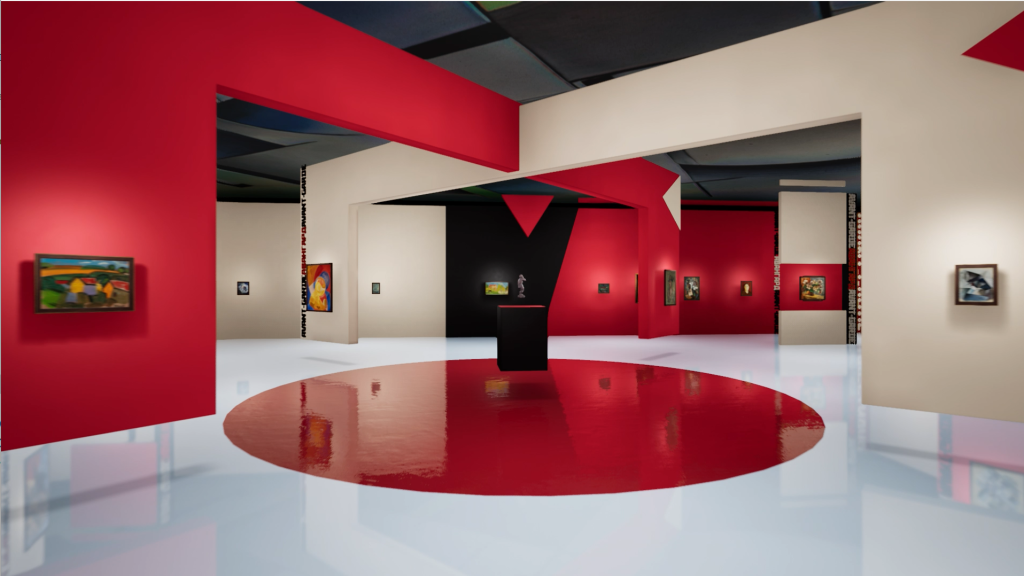
Dmitry Vatulin: The central idea of the META(art) platform is simple: to allow as many people as possible to see as many works of art as possible in 3D, not as photographs taken by a photographer or as footage filtered through a director's vision, but as they really are. When we talk about sculptures or architectural monuments, the possibility of presenting them as 100% accurate and photorealistic 3D digital replicas is revolutionary. Even paintings take on a new dimension in a virtual 3D space, allowing visitors to appreciate the ornate frames, the texture of the brushstrokes, the shiny metallic pigments, and the gold leaf on icons in a way never seen before. Another key factor is perception. When we look at an image of the Sagrada Familia, we are not actually seeing the basilica itself, but a photograph or video filtered by the artistic vision of the photographer or videographer. META(art) eliminates this filter, allowing the viewer to experience the work of art directly, without intermediaries. Certainly, virtual reality (VR) headsets would provide the most immersive way to experience art. For this reason, META(art) automatically generates a VR version of the museum alongside the browser version, without any additional effort or cost. However, VR headsets remain expensive and uncomfortable. Even among tech enthusiasts on the Steam gaming platform, less than 1.5% own a VR headset (as of February 2025). Among the general public, this percentage is even lower. One day, when VR glasses are light and comfortable, META(art) users will naturally transition to an even more immersive experience. But for now, the best way to make art universally accessible is through a standard web browser, which is already available to everyone.
PO: How would you define the concept of a "barrier-free art experience" and what challenges have you encountered in its implementation? What engine drives META(art)?
DV: A barrier-free art experience is not just a matter of convenience: it is a fundamental step in making culture accessible to people with reduced mobility, elderly visitors, and anyone who cannot physically visit a museum. We are proud that META(art) helps eliminate these barriers, transforming traditional websites—which are often mere online archives with images—into fully interactive cultural spaces. Today, all museums and galleries have a website, but these sites mainly serve as encyclopedic resources. They offer information about artworks and show images of paintings and sculptures, but they fail to capture the most important thing: the emotions and the sense of wonder that visitors experience when standing in front of a masterpiece in a real museum. META(art) closes this gap between physical and digital spaces. The platform works in any standard browser, without the need to install applications or purchase expensive equipment. The only requirement is to click a link. The biggest challenge in creating the platform was replicating the feeling of physically moving through the museum halls without turning navigation into something as complex as piloting an aircraft with hundreds of buttons and levers. It took us two years of testing with dozens of interface models until we found the one that provides a natural and comfortable experience. The core of the platform is Unreal Engine by Epic Games, a leading real-time rendering engine known for its unparalleled 3D visualization capabilities and photorealism. **PO: What advantages does META(art) offer compared to** other digital art exhibition platforms? DV: The main advantage of META(art) over other digital exhibition platforms is its exceptional accuracy and photorealism in the reproduction of 3D objects, whether they are sculptures, architectural structures, or ornate frames. Most competing platforms rely on WebGL/WebGPU, which means that rendering is done on the user's device (mobile or laptop), limiting graphics quality and the level of detail. In contrast, META(art) uses high-performance graphics servers in data centers, allowing for impeccable reproduction even of the most intricate works of art. Another major difference is the recreation of virtual showrooms. META(art) does not just place paintings on digital walls; it reconstructs entire museums in 3D with detailed atmospheres, allowing visitors to explore freely and feel the authenticity of the space. **PO: What 3D digitalization system do you use to create** exact replicas of artworks? How is META(art) optimized for mobile devices and areas with low connectivity? DV: To fully answer this question, it is essential to delve into the technical foundation of our platform. META(art) employs advanced interactive 3D streaming technology, a system that shifts all computationally intensive rendering processes to high-performance servers in data centers. Instead of processing graphics locally, the user's device receives a real-time video stream of the digital museum, similar to how YouTube sends its videos. User interactions—such as rotating, zooming, or moving through the showrooms—are sent as simple commands to the cloud, where they are processed instantly and immediately reflected on the screen. This cloud-based approach ensures that META(art) works seamlessly on any device with a standard web browser, be it a smartphone, a tablet, a laptop, or even a smart TV. Unlike conventional 3D rendering solutions, which depend on the device's internal hardware, our platform is not limited by the performance of the user's phone or computer. For optimal performance, META(art) only requires a bandwidth of 6-8 Mbps, making it accessible even in remote locations where mobile data is the only option. Of course, there are places where even this minimum bandwidth is not available. However, in those cases, it is likely that users have more urgent concerns than exploring the masterpieces of ancient artists. High-performance cloud servers generate photorealistic images in real time, allowing users to interact fluidly with 3D digital twins of the artworks. Every movement and action is processed instantly, ensuring an immersive experience without interruptions or delays. At the core of our platform is Unreal Engine, by Epic Games, the industry-leading real-time rendering engine, known for its unmatched 3D visualization capabilities and photorealism. However, even the most powerful game engine is only as good as the assets it works with. To accurately replicate the artworks, we create highly detailed 3D models of sculptures, monuments, porcelain, and even paintings. Yes, even paintings benefit from 3D digitalization. Certain artistic elements—such as the texture of the brushstrokes, the roughness of the canvas, metallic pigments, or gilding—are essential to the perception of the work. A flat photograph cannot convey these details, but a realistic 3D model allows viewers to appreciate them as if they were standing in front of the original piece. To create these ultra-detailed digital twins, we use a combination of photogrammetry, manual 3D scanning, terrestrial laser scanning, and aerial photogrammetry, depending on the characteristics of the object. These raw datasets are processed and refined to achieve museum-quality accuracy using software such as RealityCapture, Blender, 3ds Max, Substance Painter, and Photoshop, among others. Although AI-based 3D modeling tools are evolving rapidly, the role of experienced 3D artists remains irreplaceable. Every texture, material, and fine detail must be meticulously verified to avoid distortions or inaccuracies. Unlike typical 3D assets in video games or animation, the preservation of cultural heritage demands an absolute commitment to authenticity. Our mission is not just to create 3D models, but to faithfully preserve and present artworks in all their original beauty. **PO: How do you guarantee accessibility for people with** disabilities on the platform? DV: Firstly, META(art) itself fundamentally improves access to cultural spaces for people with reduced mobility. Since the COVID-19 pandemic, it has become clear that museums and galleries must expand their participation opportunities for those who cannot visit in person. However, most existing solutions focus solely on providing information—texts, images, or videos—which, while they can be very detailed, do not replicate the experience of being in a museum. META(art) transforms this approach by offering not just data, but immersive experiences. People with disabilities can tour complete museum spaces, walk through exhibition halls, examine artifacts with an impressive level of detail, and even "hold" priceless works of art that, in a real museum, are usually protected behind barriers or glass cases. Most importantly, this level of accessibility is possible on any device with a standard browser, without the need for additional software or expensive equipment. Although virtual reality headsets offer a deeper level of immersion, they are often uncomfortable, expensive, and inaccessible to many users. The platform also incorporates built-in accessibility features. Users with visual impairments can enlarge text and images using standard browser tools. Additionally, reading text is optional: visitors can press a button and a virtual AI guide will narrate the exhibition. The guide also answers any additional questions, either by voice or in writing. And, of course, it knows as much about the museum's collection as a real guide—after all, it has learned from them and never forgets anything. **PO: How does the virtual AI assistant work within** your digital museum and what kind of interactions can it have with users? Do you use artificial intelligence in other platform processes? DV: No museum is complete without a guide, and the virtual museums on the META(art) platform are no exception. Our incredibly realistic AI guides welcome visitors, accompany them through the showrooms, provide engaging explanations of the artworks, and answer questions in real time. Most notably, they are multilingual: they can communicate not only in English or Spanish, but also in Chinese, Arabic, and virtually any other major language. At the core of our AI assistant is a large language model (LLM), which can be a commercial solution (like ChatGPT) or an open-source alternative (like Llama or Mistral). The process is simple: just upload the collection data and the AI automatically structures and adapts it to a dynamic conversational format. In addition, our configuration tools allow museums to define presentation styles and response limitations, ensuring the guide conveys information in the desired tone and manner. The AI assistant speaks using Amazon Polly, a powerful text-to-speech (TTS) engine. However, as with LLMs, museums can integrate other TTS technologies, including open-source options. To ensure a natural and human presence, the guides use Unreal Engine, allowing for fluid animations, expressive gestures, and realistic facial movements, making interactions intuitive and engaging. Beyond virtual guides, we are also exploring the use of AI in 3D digitalization and optimization. However, for our specific needs, we are still in the testing and experimentation phase. Although AI-based modeling tools are evolving rapidly, we take a cautious approach to ensure that nothing compromises the accuracy and integrity of the digital replicas. AI helps us in certain aspects of 3D processing, but final verification and quality control remain in the hands of experienced 3D artists. That said, we look forward to the time when AI can take over more repetitive tasks, allowing artists to focus on the more complex and creative aspects of digital preservation. **PO: How can META(art) contribute to the preservation of** cultural heritage, especially in the case of monuments at risk of disappearing? DV: This is a particularly urgent and crucial issue. While artworks in museum collections are generally well protected, historical monuments and architectural structures are at constant risk of deterioration due to the passage of time and environmental factors. Unlike artworks, which are kept in museums where it is relatively easy to provide them with proper care, heritage sites can be found in the most remote and inaccessible regions, often a great distance from the nearest settlements. Preserving these monuments is not only a technical challenge but also extremely costly. Maintaining an architectural structure in good condition usually requires many more resources than storing a painting or a sculpture in a museum. We realized the magnitude of this challenge while working on the Sacred Geography of Kazakhstan project. Kazakhstan is a huge country; most of the 135 historical and architectural monuments included in the program are in places that are difficult to access. Many of these monuments are in critical condition, and their restoration would require enormous financial investment. In these cases, creating digital twins is not just a convenient solution, but often the only way to preserve these monuments for future generations. However, the objective is not only to create digital copies of heritage sites, but also to raise awareness and spark public interest. Reaching many of these places in person is complicated and expensive, and simple photographs of ruins often fail to capture attention. But offering a virtual tour of an ancient temple, exploring its underground chambers, or seeing its centuries-old frescoes up close does manage to capture people's interest. Especially when we can show not only the current state of the site but also a reconstruction of how it was in its glory days, restoring facades and interiors based on historical documents (where these records exist, of course). With this approach, we achieve two key objectives: 1. Cultural heritage is preserved in digital format for future generations. 2. It becomes more accessible and interesting to a wider audience today. **PO: What role do NFTs play in the platform and how** do they guarantee the authenticity and security of digital artworks? DV: On the META(art) platform, NFTs are used for their original purpose: as unique digital certificates of ownership. Contrary to popular belief, an NFT is not just an image, but verified proof of ownership over a specific digital or physical asset. In our case, it is proof of ownership of the digital twins of artworks digitalized through the META(art) platform. Each digital twin automatically receives an NFT certificate without the need for human intervention. When an artwork is added to a digital collection, an NFT is generated to secure ownership rights. An NFT purchase link is placed on the artwork's page within the virtual museum. Most importantly, it is not just an image stored on the blockchain. The NFT owner gains access to a high-resolution 3D model of the artwork. Through the NFT(art) app—developed for computers, smart TVs, and Smart TV boxes—the rightful owner can view a photorealistic and completely accurate replica of the work on their screen. This feature is especially valuable for sculptures, porcelain, and other three-dimensional objects, which can be rotated, zoomed in on, and examined from any angle. Publicly visible NFT data only contains a preview image, while high-quality 3D models are encrypted. These models can only be accessed through the NFT(art) app and by the verified owner of the NFT, who must authenticate with their cryptocurrency wallet. This encryption system ensures that our NFTs cannot be stolen (not to mention that every transaction is permanently recorded on the blockchain). NFT owners can fully customize the way their digital twins are displayed in their personal accounts within the museum website. They can organize the works in any order they prefer, set viewing durations, choose whether to show paintings with or without frames, and adjust the rotation of 3D objects. In addition, they can create personalized playlists and curate their own digital art collections, all with ease on a Smart TV or even on a traditional television with a Smart Box that costs just a few dozen euros. Thus, on the META(art) platform, NFTs are not a passing fad, but a functional tool for the authentication, protection, and monetization of digital replicas of artworks. **PO: To finish, a question I ask all my** interviewees: do you think it would be feasible to create a metaverse for traveling around the world and discovering the treasures of cultural heritage? DV: I don't think the question is whether such a metaverse should exist (it certainly should!), but when it will become a reality. I believe the key factor will be the development of lighter and more comfortable virtual reality headsets. Once this technology reaches a level of true user comfort, cultural institutions, museums, and even governments will move quickly toward the metaverse. But there is no need to wait until then. Even today, through platforms like META(art), we can create digital twins of cultural objects accessible not only through VR headsets but also on computer screens, tablets, and televisions. This is already transforming the lives of people with disabilities, the elderly, and anyone who, for various reasons, cannot travel and experience the world's great masterpieces in person. And, honestly, all of us dedicated to the preservation of cultural heritage should hurry to create our own corner within this metaverse. For many historical monuments, digital twins are their last chance to survive, not only against the passage of time but also in the face of human cruelty, ignorance, and indifference. One only has to remember the fate of Palmyra. **PO: Is there anything else you would like to add?** DV: First of all, I want to express my most sincere thanks, Dr. Ortega Ventureira, for the opportunity to share our work. I deeply admire your academic and educational contributions. In our era of flags on Mars, artificial intelligence, and digital currencies, the preservation of pa-