El valor de los gemelos digitales y el patrimonio digital
Joan Sastre explains laser scanning and photogrammetry techniques to create digital twins of cultural heritage and preserve monuments at risk.
- Interviewee
- Joan Sastre · Data Engineer
- Category
- Digitalización y documentación 3D
- Published
- 2023-02-13
Interview with Joan Sastre from the Digital Heritage Area of Integra Tecnología.
Pedro Ortega: Hello Joan. You are the head of the Digital Heritage Area at Integra. Tell us what training you recommend for a person who wants to work in Digital Heritage in a company like yours.
Joan Sastre: Hello Pedro. A true pleasure and honor to be in your internet space which, coincidentally, is named after the area I am responsible for. The good thing about being in a moment of lack of definition within our field is that specific training is not necessary to work in it. The most important thing is to have an interest in heritage and new technologies and be able to learn on the go. Of course, having a background in humanities or computer science is valued, but also in areas that initially seem to have nothing to do with heritage, such as video game design, aeronautics, law, graphic design…
PO: One of the jobs you carry out is the creation of digital twins of buildings or monuments of Cultural Heritage. What techniques do you use for this work and what resolution do you reach in the creation of these models? What are the main difficulties you encounter when making digital twins?
JS: To create these digital twins, we have the best techniques that exist today: laser scanning or structured light combined with photogrammetry. The first technique allows us to achieve a very precise definition of the shape of the objects, which translates in the 3D environment into the several billion polygons that some of our projects occupy. Regarding photogrammetry, it is the best technique for capturing the color of objects, and when reproducing it digitally, we use 16k maps. The problems when facing medium or long-range projects such as the creation of these digital twins are almost innumerable. Everything has happened to us. From sudden changes in weather conditions on the day of capture that shift the entire project to the dreaded computer failures when it has already been processing all the photos and scans for hours—which are sometimes due to the most surreal things you can imagine.
PO: Give us an example of a digital twin you have made, tell us about the experience, and give us a link so we can see it.
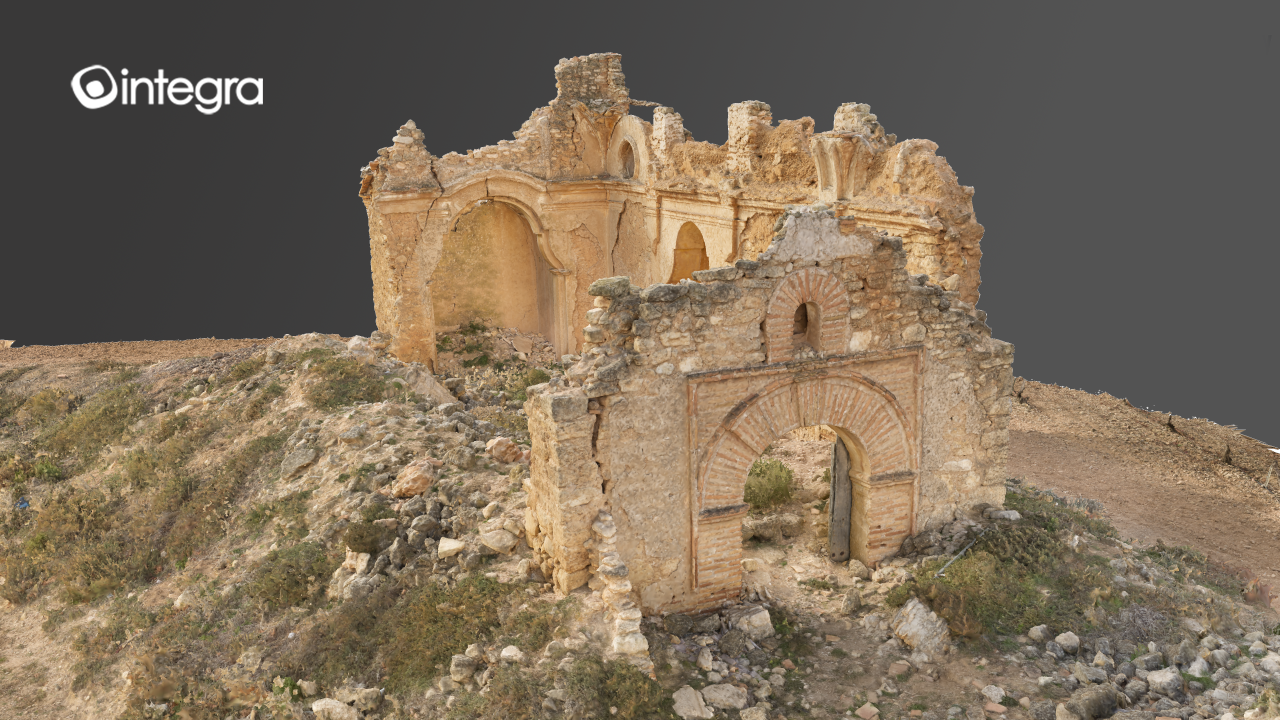
JS: A good example of our work is the Hermitage of San Gregorio de Longares. Since there have been members of Hispania Nostra in our team, we immediately learned of its inclusion in the Red List of Heritage, which identifies heritage elements at imminent risk of disappearing. We immediately got to work and were able to carry out this project aimed at its digital preservation. In this case, we only used terrestrial and aerial photogrammetry for data capture due to the speed the process required; just a few days after the news, we were already carrying out the data capture in situ—that is, the thousands of photographs that feed the software that carries out the virtual reconstruction. Due to the good weather conditions, we were able to perform the entire capture in one very intense morning, although this haste later caused some headaches when processing and generating the digital twin. However, we finally achieved a result as spectacular as what can be seen in the following link—keeping in mind that, to include a model of these characteristics in a web viewer, both the number of polygons and the resolution of the textures must be greatly reduced.
3D models by Integra Tecnología (@integratecnologia) - Sketchfab
PO: The 3D survey of buildings or monuments can also have the purpose of preventive conservation. What is required to control the deterioration of an object with a 3D survey? What projects have you carried out in this regard?
JS: 3D surveys can have several functions for the preventive conservation of a building. First, it must be considered that what is obtained with each of them is a three-dimensional still photo of a given moment in the history of a building. Therefore, it is very easy to look at this and compare it with the current building, or even with new surveys, to see where it is deteriorating and the substantial changes it is undergoing. But, in addition, surveys have proven to be a fundamental tool for seeing beyond what can be seen working with traditional tools. In our case, what happened regarding the tower of the church of the convent of San Agustín, in Belchite Viejo, is paradigmatic. This tower had been studied over the years by a good number of architects who considered that it did not face an imminent structural risk. However, as a result of the perfect orthophotos that can be generated with a 3D model, these same experts were able to verify that the degree of inclination it presented was actually much higher than they supposed. They quickly got to work and began consolidation works which, as an anecdotal fact, led to the removal of that iconic projectile that remained stuck in one of its walls during the Battle of Belchite.
PO: History can also be rewritten with digital techniques. In fact, it is impressive to see historical reconstructions of Greek or Roman temples exactly as they were initially built. What experience do you have in this regard? Can we see an example?
JS: Certainly, the application of 3D technologies allows us a wide range of possibilities. However, it must be noted that it is essential to apply a very rigorous methodology when carrying out these reconstructions, which must be based on well-founded scientific hypotheses and, furthermore, must be very transparent regarding the degrees of veracity of what is represented. In our particular case, we are not yet immersed in any project of this type; however, I can say that, within our agreement with the Institute of Heritage and Humanities of the University of Zaragoza, we are working on developing the most appropriate methodology for carrying out these reconstructions.
PO: This is a question I ask various actors within the field of Digital Heritage. We hear nothing but talk about the Metaverse, but no one facilitates a digital workspace to incorporate all the Digital Heritage already created. Do you think a Metaverse dedicated to Cultural Heritage would be viable and also profitable?
JS: It is something that sounds really promising, without a doubt. Leaving aside economic profitability and thinking rather of social profitability, the idea that appeals to us most is being able to facilitate access to all the world's cultural heritage regardless of where you are, or even your personal circumstances, through a cultural Metaverse. However, I think there is still some time to go to reach that point. At this moment, perhaps that idea of a joint workspace within the metaverse could be proposed—a meeting point for those of us who work in this field, who are actually very far apart physically. From there, progress would surely be made quickly towards something much more complex and we, as the Digital Heritage area of Integra, can help contribute a grain of sand to this fascinating project.
PO: Would you like to add anything else?
JS: I would like to thank you Pedro, for your interest in the work we are doing in favor of the digital preservation of heritage, as well as its preventive conservation and dissemination. I will keep you promptly informed of the projects we will be doing in this coming year, in which we will incorporate graphics engines such as Unreal Engine and disruptive Mixed Reality devices such as Microsoft's HoloLens 2 or IoT. A big hug.
Thank you very much for your time, Joan.