He visto cosas que no creerías…
Jesús Callejo explores archaeoastronomy and how ancient civilizations aligned their constructions with the stars.
- Interviewee
- Jesús Callejo · Jefe de Departamento de Gestión Administrativa, en Área de Gobierno de Cultura, Turismo y Deporte del Ayuntamiento de Madrid · Ayuntamiento de Madrid, Universidad Autónoma de Madrid
- Category
- Arqueología, arquitectura e ingeniería del patrimonio
- Published
- 2022-12-19
Interview with Jesús Callejo from Mindfacts.
Pedro Ortega: You have written a new book titled He visto cosas que no creerías: El legado de una España mágica (La Esfera de los Libros). In it, you deal with the concept of archaeoastronomy, a new scientific discipline that sheds much light on the importance of stars in humanity's past, as it allows us to discover the orientation and alignment of constructions, or the depiction of the gods of certain civilizations in the celestial bodies. Tell us about some of the evidence this discipline has provided and what is expected in this field for the future.
Jesús Callejo: The truth is that it is an interdisciplinary field of study based on the use of written and unwritten evidence to study the astronomy of other cultures in depth, and that gives us clues about the orientations of certain religious buildings. They provide very valuable data about those wise builders of ancient civilizations who knew how to align their temples toward very specific stars, based on their knowledge of the universe. Certain constellations such as the Pleiades, Orion, Virgo, or Ursa Major have served as references in these constructions. In the prehistoric site of Newgrange, during the winter solstice, the first rays of sun flood the inner chamber after passing through a 19-meter-long passage. At the Temple of Kukulcán, in Chichen Itzá, during the spring and autumn equinoxes, sunlight hits the pyramid in such a way that a snake-shaped shadow surfs along its 91 steps. At the Pantheon of Agrippa in Rome, when sunlight enters through its oculus on April 21—the traditional anniversary of the founding of Rome—it is redirected to the entrance of the monument. Not to mention the “miracles of the equinoctial light” that occur every year in San Juan de Ortega, Santa Marta de Tera, or the church of Briviesca, to name just three examples. In other words, for thousands of years, people knew how to “mark” the solstices and equinoxes with rituals and celebrations and knew how to reflect on the ground what they saw in the sky.
PO: Another general-use tool with great potential for making major discoveries has been Google Earth. What light has this tool shed so far on the history of civilizations? What other findings are expected?
JC: Well, more precise data is being obtained regarding locations and orientations. High-resolution satellite images from Google revealed 2,000 new sites with archaeological potential in Saudi Arabia in 2011. Of all the discoveries, more than a thousand correspond to teardrop-shaped carved stone tombs. If we talk about the chapel of San Bartolomé in the Río Lobos Canyon, thanks to Google Earth maps, we now know that the result of its equidistance to the easternmost and westernmost capes of the Iberian Peninsula is exact. From San Bartolomé to Cape Creus it is 532 kilometers and 744 meters, and from San Bartolomé to Cape Touriñán it is 532 kilometers and 793 meters. It cannot be a coincidence. In the book by researcher Rodrigo González Castro (“La ruta de Melkart”), using this Google Earth tool, as well as toponymy and sacred geography, he proposes a peculiar theory in which he attempts to reveal where the Camino de Santiago actually ends, where the famous Pillars of Hercules were, or the exact location of the Atlantis mentioned by Plato.
PO: In this sense, and on a smaller scale, the use of drones with LiDAR devices has made it possible to locate sites covered by forest. I know that some Iberian sites have been found with this technology in Castilla La Mancha. What else has this combination of tools discovered for us?
JC: In recent years, LiDAR technology has represented both an evolution and a revolution for the study of archaeological sites. It offers possibilities for studying locations without the need for excavation work, with the consequent preservation of remains. This technology allows for the application of a non-invasive and systematic prospection methodology carried out from an office, and the first to use it were Mesoamerican archaeologists in 2009, with the discovery of the Mayan city of Caracol, in Belize. Irrigation systems, roads, crop fields, and even pyramids are some of the nearly 61,500 Mayan structures found in 2018 under the jungle vegetation of northern Guatemala thanks to a scan made with this laser technology. A Hispanic example would be the combined use of LiDAR, thermal photography, ground-penetrating radar, and a three-dimensional survey of certain areas, which has allowed for the analysis of the Visigothic urban center of Recópolis, in Zorita de los Canes, equipped with a walled enclosure nearly two kilometers in perimeter, making it one of the most extensive known so far in the Iberian Peninsula.
PO: Artificial intelligence is a field that is as exciting as it is dangerous. For example, in the field of arts, canvases have been created using artificial intelligence by extracting the characteristics of a specific artist to create impossible paintings... Do you believe the evolution of artificial intelligence will surpass human intelligence? And do you think it can replace art?
JC: New technologies, and artificial intelligence (AI) in particular, are drastically changing the way we perceive the world, as well as the nature of creative processes. Computers play very significant roles in the creation of music, architecture, fine arts, and science. In fact, the computer is already a canvas, a brush, or a musical instrument. And a time will come when AI surpasses human intelligence in various fields of knowledge, as is already happening with chess. It is inevitable. Many still resort to the Turing test to calculate the value of artifacts and supposed works of art produced by their software. That is, if a certain number of people cannot determine which of the works were generated by a computer and which by a human being, then the software works. And therein lies the danger. If we are unable to distinguish an artistic work made by humans from one made by a robot, they are going to pull the rug out from under us. We are moving toward a metaverse that is exciting but also worrying depending on how we use it.
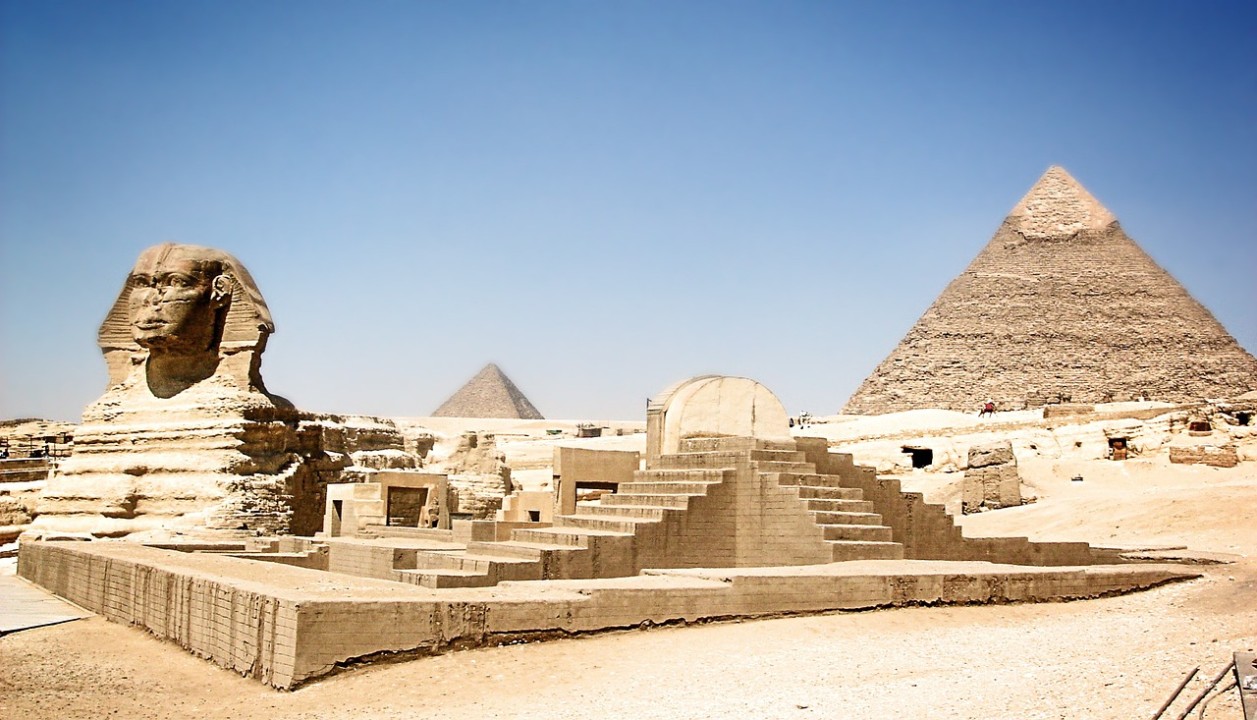
PO: If there is one enigmatic set of buildings across the five continents, it is the Giza Pyramid complex. What new technologies have been used or will be used there? Is there any evidence following the use of these techniques?
JC: 3D digital models of the pyramids are being created using laser scanners and photogrammetry, a technique that uses photographs and videos captured from different angles. Between 2015 and 2017, the Scan Pyramids project managed to establish the existence of unexplored voids in the Pyramid of Cheops through the analysis of muon beams. So-called muon telescopes can detect the impact of cosmic rays on rocks, and in this way register gaps in the construction of a building. In 2022, a team of physicists and archaeologists, led by Alan Bross, obtained permission from the Egyptian government to use this high-sensitivity cosmic ray technology to scan the Great Pyramid of Giza in search of possible secret passages and chambers, which are known to exist.
PO: On a Mindfacts program, you mentioned a technology you would like to own: augmented reality glasses to be able to reach archaeological sites and see how they were originally: their structure, their colors, their inhabitants… Do you think we are far from achieving this?
JC: It is already starting to become a palpable fact. Virtual reality was the precursor technology for experiencing immersive cultural experiences during tourist visits, through computer reconstruction of places as they were in the past (for example, Pompeii), and feeling inside them by viewing them with special glasses or visors. Augmented reality is the new technological evolution that is allowing the expansion of the option to visualize real archaeological sites through a technological device (generally through mobile phone applications) with added graphic information. It combines tangible physical elements with virtual elements. And now a third variant is emerging: so-called mixed or hybrid reality, where the combination of virtual and augmented reality allows for interaction with objects, people, or characters. It's amazing.
PO: And finally, a question I ask all my interviewees about the metaverse: do you think we will be able to build a space where we could go, thanks to virtual reality, to all the enclaves of the past? A tool like a 3D Wikipedia with global and free access. What do we need to get there?
JC: There are very attractive proposals that combine the digital recreation of the original constructions of a palace or a mausoleum with the filming of other scenes such as gladiator battles, which help the visitor immerse themselves in the recreation of ancient settings. There are smart glasses for visiting the Roman theater and amphitheater of Mérida, where one can witness gladiator fights or a performance of a play and see how the Roman constructions of places like Cambrils-La Llosa (Tarragona), Cartagena, Segóbriga, or Tongóbriga (in Portugal) originally looked. Within the "infinite" possibilities of this technology, the virtual reconstruction of the history of Madrid's Plaza Mayor, from the 17th century to today, is included. The goal is to recreate any scene with hyper-realism (for example, an Inquisition Auto de Fe) and distance it from the appearance of a video game.
PO: Would you like to add anything else?
JC: For those of us who love history, anthropology, archaeology, or art in general, current science and cutting-edge technology are lending us a hand. The idea sought is to move from listening to a tour guide telling you a story or a legend to taking a step forward and being able to visualize the site to scale, contrasting each element and transforming it into what it was in its origin. That is going to surprise us and increase the desire to go and experience it in the present. For that reason alone, legends and tourist routes will take on another, much more fascinating dimension.
Thank you very much for your collaboration.