Un referente de la reconstrucción virtual histórica en España
Born in Barcelona, Josep holds a higher degree in Industrial Design and a Master's in Automotive Design. He studied in Sabadell and Barcelona, balancing his studies for years with work at his father's architectural firm, which provided him with the general knowledge that allowed him to...
- Interviewee
- Josep R. Casals · Digital Heritage · JR.Casals - Digital Heritage, Escola Superior de Disseny ESDi
- Category
- Reconstrucción virtual e inmersión
- Published
- 2024-09-13
Interview with Josep R. Casals
Pedro Ortega: Talking about J.R. Casals is talking about a benchmark in Spain regarding historical virtual reconstructions. How did your career in this field begin? What were the first tools you used, and how have you seen the evolution of software and hardware intended for the recreation of vanished historical spaces?
J.R. Casals: Thank you very much for considering me a benchmark; I have spent about 12 years dedicated to this profession, but I always think I still have everything to learn. I started almost by chance, after a few years of experimenting with some projects on my own. By university training, I am an industrial designer and came from working in fields as diverse as automotive design, product development, architecture, and interior design. I had done a bit of everything without being an expert in anything, but the use of advanced 3D tools in all those sectors—from concept design and prototyping to my own experience in architecture, where I worked for a few years designing alongside my father, now a retired architect—made me think it was possible to apply all those techniques to the reconstruction of historical buildings and cities. Furthermore, having that affinity for architecture, despite not being a career architect, I had a great curiosity to understand what all those buildings and cities of the past would have been like. Around 2005, there were starting to be some 3D reconstruction works of historical sites, but it was something incipient in our country, and I don't even think it could be considered a profession yet. So, I started doing some projects to experiment in parallel with my regular work, looking for a way to enter that sector. It was at the end of 2012 when I had the opportunity to start working on my first project with the UB, taking over from someone who left the project with the 3D half-finished. I believe that after these years, we essentially continue working with the same software as back then, but the changes have been enormous with the emergence of real-time Raytrace, parallel to the great development of hardware and graphics card technology, VR, and more recently, AI. I started working in 3D Studio Max during my Industrial Design degree in 1996, although all types of design and engineering software, as well as generalist software, have passed through my hands. In these years, I have seen a great evolution, but I think in the last 5 years I have seen bigger changes than in the previous 20.
PO: Following up on what we were discussing, I wanted to ask you what equipment and programs you currently use. Have you used NVIDIA Omniverse? How do you see the technological evolution in this field?
JRC: I use a conventional PC with the characteristics of what we call a Gaming PC, since our work is more like a video game than the engineering or simulation work that demands other types of equipment. Therefore, a powerful i9 with all the RAM supported by the motherboard, good SSDs for fast access, and a good graphics card, which I have just updated to an RTX 4080 Super. I have always worked in 3D Studio Max, to which must be added the usual Adobe suite, including the Substance pack and other specific tools that need to be incorporated into the workflow as needed. But my big leap was incorporating Unreal Engine into some of my projects as a new working method that never stops evolving. With the colleagues from the Construyendo Tarteso 2.0 team, we have been pioneers in our country by applying it to the reconstruction work of an active archaeological site such as El Turuñuelo as a research and dissemination tool. I worked with Unity in interior design, but it never convinced me because the visual quality was far below offline rendering engines. With the incorporation of real-time Raytrace in Unreal, I started doing tests and incorporated it as an experimental method in two long-term projects that allowed me to develop a new working system without the pressure of deadlines; that was in 2019, and from then on, I apply it to many projects. I haven't used NVIDIA Omniverse; my work remains quite artisanal even though I use advanced technology, and since I don't work in large teams, I still believe more in local work and adapting my workflow to my needs without large investments. Technology is evolving very fast; I am very attentive to the evolution of video game rendering engines, such as Unreal and others, and to the advantages that AI can bring us in technical terms, with the development of new tools or the improvement of those we already use regularly, so that our work increasingly focuses on the technical and artistic aspects of the project, rather than the mastery of software or specific working techniques.
PO: Reviewing your career, we can see that one of the eras you have worked on most is the Roman Empire, with the recreation of several cities in Spain but also Rome itself, such as a spectacular view of the Domus Aurea. I believe that with these works you opened the field of 3D illustration of Roman cities that are partially preserved in the Peninsula. What have been the main uses of these recreations?
JRC: Yes, the large presence of Roman remains in our country makes it a fairly common type of work, both due to the interest of institutions in the conservation and dissemination of those sites and due to the interest of the public, who usually know more about the Roman past than other periods of history. In the cases of the Domus Aurea and a cutaway view I did of the Colosseum in Rome, they were reconstructions I carried out for the archaeology magazine Desperta Ferro, for which I have worked extensively. I did a series of Roman cities in the province of Segovia, to which we must add Termes in Soria as they are in the same orbit, with which a dual purpose was intended: on one hand, to have images that reflect the studies carried out by researchers excavating these cities, as in the end, it is necessary material for conferences and publications; and on the other hand, to use those images for exhibitions and for panels that will be installed on-site when they are prepared for visits. Also with the same purposes, I have reconstructed some Roman villas and baths, but there is one city that I am particularly excited about, which is Augusta Emerita. I carried out this complete reconstruction of the city—as in the cases of Rome—for Desperta Ferro magazine, and over the years, this work has borne other fruit with the reconstruction of expanded areas with greater detail of the city that will be exhibited in a museum of a Roman city in Germany this autumn. Now I am working with other museums, such as the Archaeological Museum of the Community of Madrid in Alcalá de Henares and the MNAR in Mérida, which have commissioned other new reconstructions of Roman complexes that are already in production, but I cannot reveal anything until they are published next year.
PO: You have also made forays into medieval constructions such as castles and cathedrals. Which of these buildings are you most proud of, or do you believe is more faithful to historical reality?
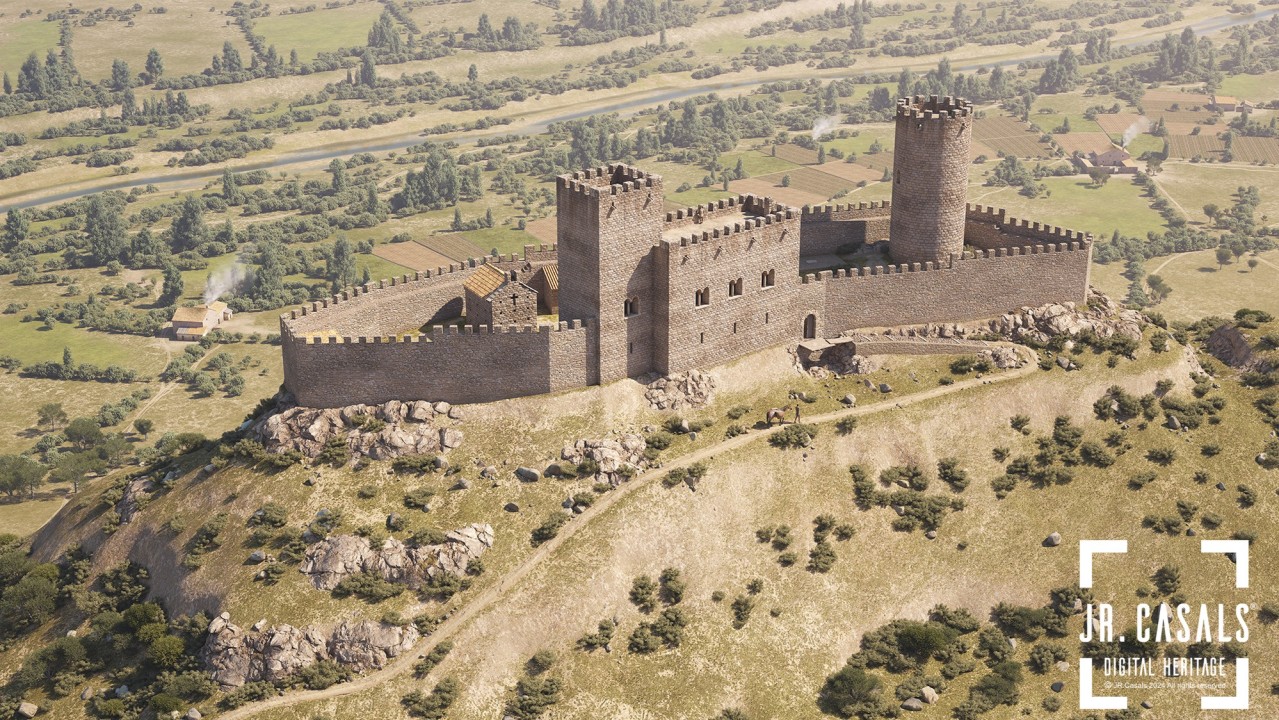
JRC: From the medieval period, I have done some work in Spain; on one hand, the illustrations of some Romanesque and Gothic cathedrals for Desperta Ferro, some of them with cutaway views that show the structure in a didactic way to understand how they are built. On the other hand, I have done reconstructions based on historical and archaeological documentation of castles that have disappeared today, which is a challenge involving several professionals to be able to shape a complex that presents few tangible remains and which, based on existing documentation and contemporary parallels, must be defined in dimensions, architecture, and topography to build a hypothesis that will never be 100% correct, although it will be quite close to what it might have been in its time and will be plausible. But what gives me great emotion is working for English Heritage, reconstructing medieval castles and abbeys in England, although I have even done a Roman city with them. It has been one of those leaps into the void that provoke excitement and respect in equal measure, due to the responsibility representing putting my work at the service of an institution of that caliber, and due to the great change in the architecture and landscape itself, far from my usual environment. Working with English historians and archaeologists is proving to be a great experience due to the great precision and rigor we apply to each reconstruction, leaving no detail to chance and even completely reconstructing the architecture of the complex even though many of its parts remain hidden in the final image presented to the public. The general objective is for the visitor to be able to see in images what that building was like, both on explanatory panels at the site and in a published guide, but with this exhaustive working method, the aim is to create a complete reconstruction of the architecture that will remain as part of the research of the site and as documentation for the future of the institution.
PO: A facet of yours that I was unaware of is the recreation of fighter planes from the Civil War and World War II. What uses have been given to these recreations? Perhaps some have been used in a video game?
JRC: Those fighter planes are some of those that participated in the Spanish Civil War; I made them for a series of illustrations for a book about the bombings in Catalonia during the war, which open each of the chapters. My way of working always starts with 3D production, but in this work, there were aerial views in wide shots, such as the bombing of Barcelona, so it was necessary to make a mix of 2D illustration created from historical aerial photos and 3D parts—basically the planes, but also some of the settings that required views closer to the ground. The advantage of making the planes in 3D is that I could reuse them in different illustrations and for later uses, which is essentially one of the great advantages of 3D work: the reuse, revision, and updating that always allow us to adapt to new circumstances. For example, I used the Polikarpov i-15 "chato" for another Desperta Ferro illustration about the retreat of the national troops in Guadalajara, adapting the wing color schemes to the exact model of that historical moment. These models could be used perfectly in a video game, although they would require deep revision and optimization because they are not designed for that, but that is the advantage of digital work: adaptability.
PO: You have also touched upon the theme of contemporary architecture with examples like the Fine Arts Palace in Donostia. Unfortunately, many buildings from this era have been demolished to make way for new buildings. In that sense, I wanted to ask you about Art Nouveau, one of the styles that has suffered the most. Have you recreated any vanished Modernist buildings?
JRC: I really liked doing the Fine Arts case because I was able to participate in the project of a group of architects dedicated precisely to denouncing the loss of architectural heritage that Donostia has suffered for decades and which, far from decreasing, is accelerating. It is sad that buildings that were a benchmark at the time of their construction are so little valued, such as this wonderful building by Ramón Cortázar from 1914 inspired by the vanished Gaumont Palace in Paris, which was the first designed in our country with a reinforced concrete structure. It has been mutilated on several occasions without any consideration, and now a renovation for its reuse for other purposes is dismantling it definitively. Unfortunately, this is happening across the length and breadth of our country, and we must not only think about buildings several centuries old that disappear due to neglect and lack of rehabilitation; the serious thing is that there is absolute blindness regarding 20th-century architecture which, in the eyes of the authorities, is "out of fashion," but it can be representative of a way of doing things and a style that is disappearing at a forced march, as happens, for example, with industrial architecture and the first train stations. I haven't had the chance to work on Modernist buildings; it would be wonderful to work with buildings by the great Catalan Modernist architects, although it is a great challenge to reproduce that profusion of organic forms, impossible details, and textures. Right now, I am just starting one of the projects that comes closest in era and style, although it is industrial architecture; I am particularly excited because it is an exponent of industrial heritage from the early 20th century in Catalonia.
PO: A curiosity in your portfolio is an uchronia: the Trajan Machine. What can you tell us about this supposed machine? What other uchronias have you designed?
JRC: It is a truly curious case within my portfolio of works; the truth is that I never thought I would be commissioned something like that by Desperta Ferro, and I am enormously grateful for the freshness and the boldness to think about "what would have happened if... ". They made a very interesting bet with the special series of Uchronias, in an exercise of counterfactual history posing what would have happened if the Roman Empire had continued developing. This is analyzed from many points of view, always based on the historical knowledge of the authors of the articles and on solid scientific bases, and they proposed that I illustrate the chapter dedicated to a mechanized empire thanks to steam power. I didn't hesitate for a moment to accept, as this awakened my old industrial designer profile by entering fully into historical reconstruction. The premise of the work was based on the existence of the aeolipile or "wind ball" described by Vitruvius, which showed that already in the 1st century, steam power was known as a motive element. So, the idea was to design something similar to a steam locomotive that would move along a sort of tracks transporting coal or other raw materials through the Empire. From there, I developed the idea of the basic operation of steam generation in a boiler and the use of a turbine that would move the transmission, generating a somewhat crazy hypothesis without reaching a definition at an engineering level, just a concept that could be plausible. And all this had to be dressed in the style and way of doing things of the Romans, so I put special interest in reflecting a technological level and mastery of materials consistent with the era to separate it from our image of 19th-century steam engines, and also to think about the design at a more artistic level because the Romans, while being absolutely practical, always imprinted a very special character on their objects. I haven't had the opportunity to do more works like this, but I would love to because they bring freshness to the academic world and create entertainment based on historical data; this could be a truly interesting genre to develop more extensively, not just occasionally but as a definition of all the elements of a society that could have existed.
PO: One of my dreams is to be able to access a metaverse containing cultural heritage in virtual reality. Do you see it as possible? Could your designs be included in a project like this?
JRC: Of course, all the material we generate in digital format is always transferable to some type of metaverse, which in some way I believe we will one day see, but I don't think it will be soon, as I don't believe much in the idea of the metaverse as it has been proposed until now. I don't think the idea of the metaverse as Meta sells it—as a "virtual site" where we will go to live our lives, events, meetings, etc.—makes much sense; it seems like something designed to sell virtual plots, and I think we don't need to go to more places virtually nor install virtual sites in a meta-place, even if it sounds silly put that way. I think the current network itself is already like a metaverse. What's missing is a real and direct interconnection, an order, but also legislation, limits, and functional tools. And in the section of functional tools—the physical ones—is where I think we are most lacking and where technology still has a long way to go. VR is a great technological step towards immersion in the virtual world and the blending of the virtual and the real, but it hasn't quite taken off for many reasons, mainly technological and functional, but I believe we are on the right track so that one day it will be possible to integrate everything. My idea of the metaverse is that my house is the metaverse, that my city is the metaverse, that there is no inside and outside, but rather that I can integrate it comfortably, but that remains in a very theoretical framework, and I haven't delved into it because I think we still have quite a way to go.
PO: To finish, I'd like to ask what projects you are currently carrying out.
JRC: Currently, I am working on many projects at once, since on one hand, there are research works in which I have a more or less continuous collaboration, and then projects that have a beginning and an end. Of the former, I must highlight the work we carry out with the Construyendo Tarteso team at the Turuñuelo site (Guareña, Badajoz), as it is a project that joins the dynamic virtual reconstruction of the site with technological research, working with Unreal Engine as a platform that is constantly evolving towards any digital format that can be developed, whether it be desktop, mobile VR, or the metaverse we were talking about. I also collaborate on other projects where we will surely follow the steps of what was learned at El Turuñuelo, such as Sant Jaume d’Alcanar (Tarragona) or the Roman fortification of Olèrdola (Barcelona). These projects are very interesting because they allow me contact with the world of research, which is very different from projects designed for tourism development or institutional heritage, even if we work with the same tools. Regarding the other projects I have underway, I can say that I am in the final phase of a rather extensive reconstruction of a castle in England with English Heritage, in two different construction phases; that I am continuing with some expansions of a large project we have been carrying out since 2020 in La Garriga (Barcelona) from 1716; and I am finishing another large reconstruction of an important Catalan heritage site from the 18th century. While all this is happening, I am already starting new projects that will occupy the latter part of the year and part of the next, such as a coastal town in the Mediterranean Levant in the 18th century, one of the jewels of Catalonia's industrial heritage from the early 20th century, and several Roman sites across the peninsula—all projects that we will reveal as they are published.
PO: Would you like to add anything else?
JRC: I would like to add that this is an exciting profession and that it is open to the participation of a great variety of professionals. In the same way that zoologists, architects, or paleobotanists, and many other researchers and professionals from other disciplines can work on archaeological sites, the same happens in Virtual Reconstruction; we must think of a multidisciplinary profession where there is room for professionals with different profiles, each with their background and tools, so they can contribute different points of view and new work systems. And to the young people starting out and wanting to dedicate themselves to this profession, I would encourage them to constantly train in the technological and software section; today everything is very fast and changing, and it is necessary to know how to set goals well and not get carried away by the promises of miraculous technologies. We haven't addressed the topic of AI, but like all disruptive technology, it will move from its phase of creating false expectations to a more realistic phase where we can really explore what possibilities it offers us to improve our workflow. But real work is complex; it requires effort, adaptability, and constant learning—there are no miraculous solutions. I would also like to thank all the clients and teams I collaborate with for having trusted my work, especially those who allowed me to start this career, such as Joan Santacana and his team from the UB, and F. Xavier Hernandez Cardona and his research team Didpatri, also from the UB; they planted the seed, and now I can say that I have dedicated more years to this field than to any other field in my profession as a designer and 3D expert.