Tecnología aplicada al patrimonio y la arqueología
Pablo Aparicio from 3D STOA explains how to recreate archaeological heritage in 3D with scientific rigor and discusses the training opportunities available in this discipline.
- Interviewee
- Pablo Aparicio · Socio fundador en 3D Stoa - Patrimonio y Tecnología · 3D Stoa - Patrimonio y Tecnología, Universitat d'Alacant / Universidad de Alicante
- Category
- Reconstrucción virtual e inmersión
- Published
- 2022-12-12
Interview with Pablo Aparicio from 3D STOA.
Pedro Ortega: 3D Stoa is a collective of professionals dedicated to the digitization of cultural heritage and archaeology. How do you establish the foundation of your work when recreating an element from the past in 3D based on archaeological evidence? What degree of veracity is achieved with these recreations?
Pablo Aparicio: Indeed, historical-archaeological documentation is the fundamental basis for carrying out a good 3D reconstruction or recreation of heritage. To do this, we work with the best professionals on each project, often the archaeologists who have studied a specific heritage asset, in order to have the most appropriate foundations for its recreation.
Regarding the degree of veracity, it is never an objective level nor can it be defined exactly, but we use tools such as the historical-archaeological evidence scale which allow us to be transparent with the different levels of evidence for each part of a virtual reconstruction. Tools like this—or others such as the Extended Matrix—are fundamental to providing our work with a scientific framework.
PO: I am very interested in training for the creation of heritage and archaeological elements in 3D. What kind of courses do you offer and what profiles are necessary to train as a professional in this field?
PA: In a discipline like ours, offering accessible training beyond universities or formal centers is fundamental to helping everyone interested improve their technique and learn new skills. This is why we promote KORÉ – Online training in heritage and technology. In this online school, we offer courses on virtual reconstruction, city or character recreation, but also on 3D photogrammetric documentation, model optimization, 3D printing, 3D animation, virtual and augmented reality, etc.
Our intention is to always be accessible to everyone, so the only requirement needed to take the courses is to show interest and have a suitable PC for each one (minimum hardware requirements are usually not very demanding), as most of our courses include "level zero" introductory modules for the most complex software.
PO: In particular, I wanted to ask you about the tool Blender. Is it very complex to create virtual objects with this free application? Any advantages or disadvantages compared to paid tools?
PA: Blender is an extremely powerful software that has nothing to envy of other similar paid applications (such as Maya or 3ds Max). In that sense, it is perhaps a rare bird in the software world, as it is not easy to find free applications that rival their paid counterparts so competently. The advantages of using it are many, not only the fact that it is free, but also the immense amount of Blender video tutorials available on the web or the constant updating and improvement of the software by the developer community.
As for its ease of use, being complex software, it requires a certain level of learning, but at KORÉ we try to make the complicated simple, and within a few weeks, our students become proficient with this program thanks to our introductory courses.
PO: The latest projects you have carried out are very interesting. I wanted to ask you about three of them: the Old St. Peter's Basilica, beneath the current one in the Vatican, the work on the Segovia Aqueduct, and the Roman ship Bou Ferrer.
PA: These are three examples of virtual reconstruction that we are undoubtedly most fond of. The first one we carried out was the work centered on the Roman aqueduct of Segovia, which we documented in 3D with millimeter precision and used as a base to recreate part of 16th-century Segovia and, specifically, the Plaza del Azoguejo in 1520. This served to accommodate a project that recreates the moment when the Virgin of the Aqueduct was placed in the niche of this Roman work, which crystallized into an interactive website and an educational audiovisual piece that can be enjoyed today at the Casa de la Moneda in Segovia.
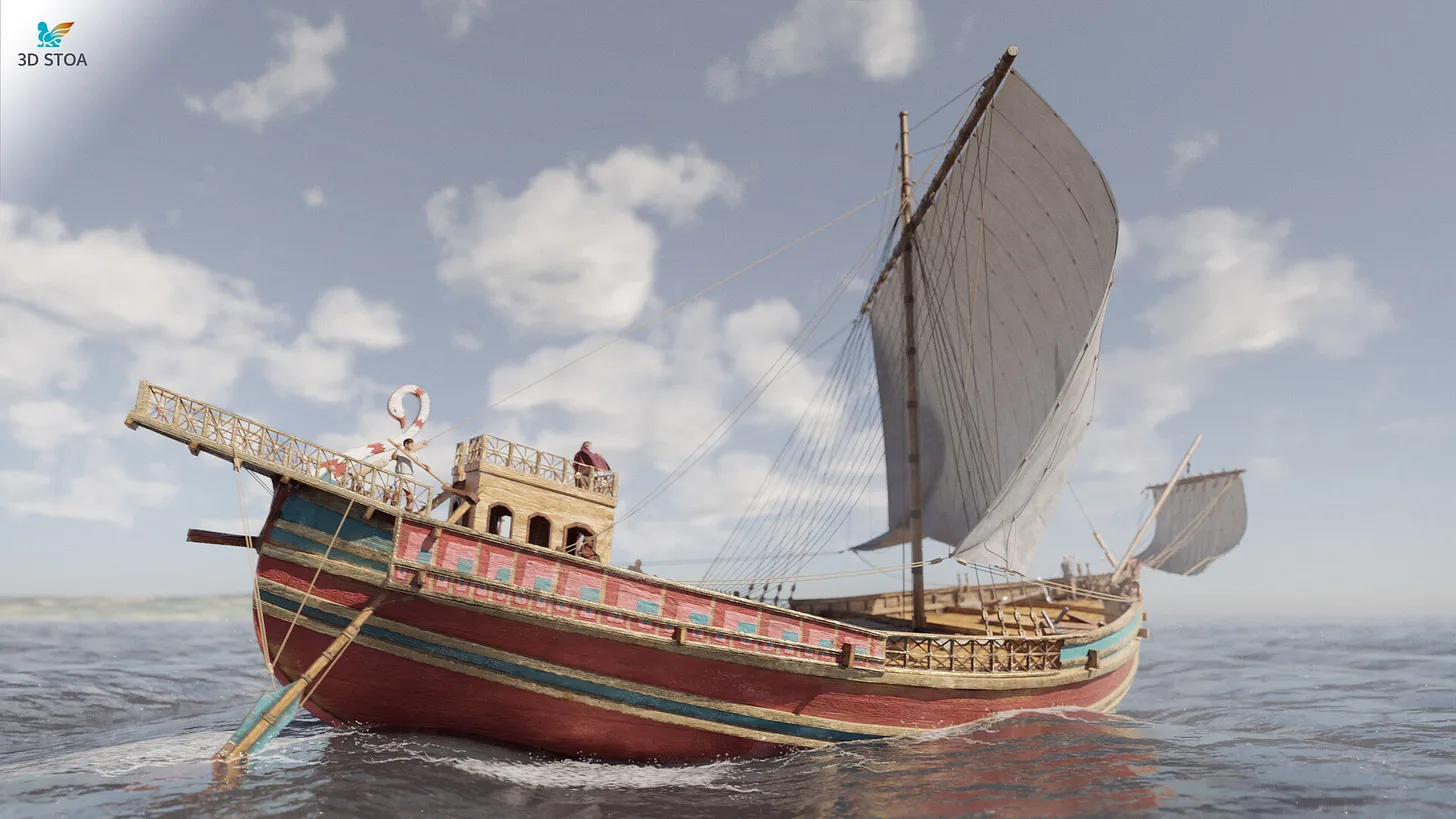
The virtual reconstruction of the Roman shipwreck Bou Ferrer was one of those projects that led us to push the boundaries of our own work and learn new techniques. The objective was to design a reconstruction hypothesis for this important Roman ship, found off the coast of Vila Joiosa, based on archaeological remains and historical documentation. To do this, we collaborated with Antonio Espinosa, Carlos de Juan, and Vladimir Herrero, some of the leading experts on the ship, and we developed its virtual reconstruction and a 3D animation of its final voyage which has not yet been fully published; we hope it can be seen in its entirety soon.
Finally, the virtual reconstruction of the St. Peter's Basilica in the Vatican was a project that arose from the "Blender for virtual 3D reconstruction of heritage" course that I taught during the summer of 2022. To prepare and guide this course, I carried out this virtual reconstruction based on exhaustive documentation and historical-archaeological and historical-artistic research; this allowed us to recover the original appearance of this building in the 4th century. Furthermore, having this project will make it easier for us, in the future, to create virtual or augmented reality experiences that go beyond the images and videos presented so far.
PO: Following the previous question, I wanted to know the reason for your fascination with the Roman Empire. Additionally, you run a very curious project to learn about Rome called "Antigua Roma al Día."
PA: We trained in technology applied to heritage but, before that, we studied History, Art History, and Archaeology. We have worked as archaeologists on multiple archaeological excavations and, during this learning process, you always end up developing a certain affection for specific cultures and historical periods. In our case, although we have also worked on protohistoric, medieval, modern, and contemporary periods, the Roman world has marked us in a special way. And, above all, it has marked our colleague Néstor F. Marqués, who for more than ten years has promoted the outreach project Antigua Roma al Día, which includes everything from the publication of educational books to the management of social networks focused on ancient Rome and guided accompaniment on cultural trips.
PO: You also deal with photogrammetry. In this sense, what projects have you carried out or which ones are you working on?
PA: Indeed, digital photogrammetry is a 3D documentation technique that is already fully widespread and has impressive possibilities: from well-taken photographs, digital twins of heritage assets of the highest possible quality can be obtained. Because of this, we actually use this technique in almost all our projects, since even in purely virtual reconstruction projects, it is very interesting for us to have a photogrammetric base that allows us to start from the most precise documentation.
As for photogrammetric documentation projects we have carried out, highlights perhaps include the Civil War trench lines of the Community of Madrid or the medieval castle of Montsoriu, in Girona, but also the documentation of museum pieces such as the collection of Greek vases from the National Archaeological Museum or part of the collection of Vilamuseu. Currently, we are tackling new and important 3D documentation projects including numerous museums across our geography, about which we will soon be able to say much more.
PO: Recently you have started offering a series of new higher-level courses. What are these courses and what skills can be developed with them?
PA: Our students very often ask us for new courses with which to continue developing their skills and keep learning with us; that is why we try to expand our training offer with new courses that further extend both the number of tools we teach to use and the depth of knowledge we transmit. Thus, we developed advanced photogrammetry courses, covering techniques such as the use of drones, underwater photogrammetry, or the combination of photogrammetry with laser scanners, or specific micro-courses for Blender like the introduction to 3D animation with Blender, which allows our students to start producing their own audiovisual products.
PO: Finally, I have a question that I am asking various actors within Digital Heritage. We are seeing the development of the "Metaverse," but I don't see that a unified virtual space yet exists where all 3D surveys of heritage elements, whether present or past, can be located. This seems like a fundamental issue to me. What do you think about this? Would you be willing to collaborate on a heritage Metaverse project? What could you contribute?
PA: Of course, it would be very interesting to work on a common "virtual space" where the different heritage surveys of the world could be found. The closest thing is Sketchfab, as that is where the vast majority of photogrammetric and scanned 3D models of heritage elements are located, even within official accounts of museums and projects of varying importance. However, Sketchfab is not an exclusive heritage platform nor does it perhaps have the characteristics of a virtual repository for heritage surveys.
In our opinion, if this "patriverso" or heritage metaverse were to be designed, the most important thing would be to design some common minimum criteria that allow for high-quality and optimized 3D models, in a reviewed and scientific manner. It is a utopia toward which we must try to walk.
PO: Is there anything else you would like to mention for the readers of the "Patrimonio Digital" newsletter?
PA: Simply to say thank you for the interest in our work and to invite you to stay tuned to our social networks (Facebook, Twitter, Instagram, and LinkedIn) to learn about the upcoming projects we are going to launch, as 2023 will bring many new things: a complete overhaul of the KORÉ platform, new projects that we hope will revolutionize the way we understand the use of historical assets, more presence of Unreal Engine in our projects, etc. There is much work ahead!