Tecnología y derechos culturales
Javier Lacort, a Xataka journalist specializing in AI, hardware, and digital business, analyzes the real state of cultural accessibility: AR glasses, LiDAR, simultaneous translation, and the biases of large language models.
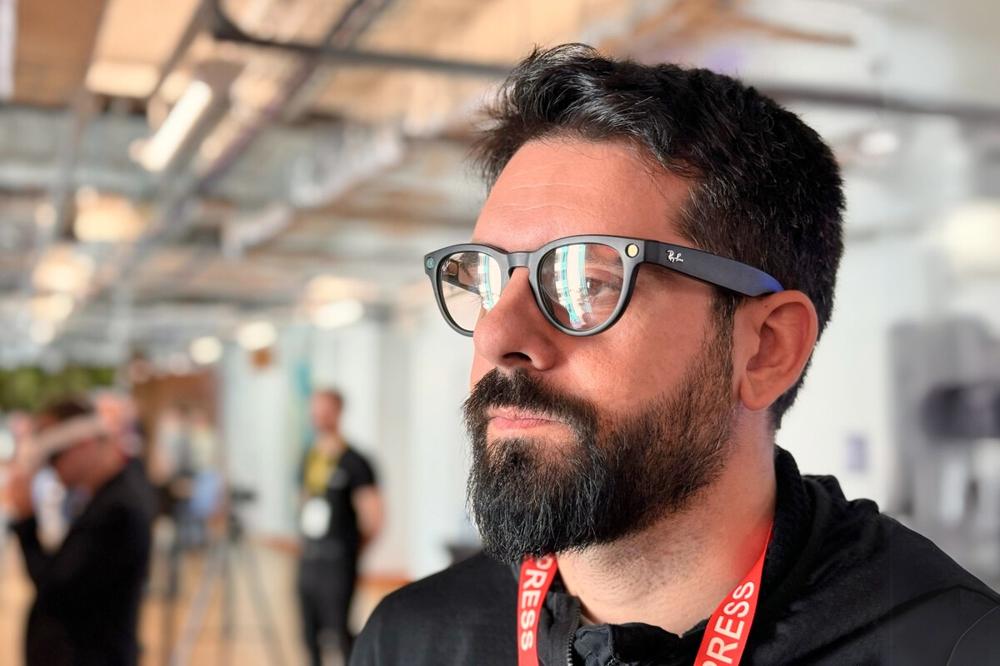
- Interviewee
- Javier Lacort · Periodista especializado en tecnología, IA y negocio digital · Xataka / Loop Infinito
- Category
- Inteligencia Artificial y tecnologías emergentes
- Published
- 2026-01-27
Pedro Ortega: The Ray-Ban Meta Display are positioning themselves as an accessible Augmented Reality tool. From your experience covering technology, do you think we are close to seeing layers of cultural information in real time (such as contextual subtitling in museums or historical data on buildings or monuments) integrated naturally into these types of devices? Javier Lacort: With the Display we are closer than with the basic Ray-Ban Meta, but there is still a way to go. The Display has a 600x600 pixel monocular screen with brightness up to 5,000 nits, which allows viewing overlaid information, in principle, even outdoors without any problem. The six-hour battery life is already reasonable for a full cultural visit, and the neural wristband eliminates the need to be talking to the glasses in a museum. In general, the hardware is maturing little by little. The problem remains in the infrastructure: you need very precise mapping of spaces, updated databases, agreements with cultural institutions… Meta has the muscle to push this, but its business model goes another way, towards social content, video calls, the viralizable short video that no one asked for but that hooks you… For real cultural use, museums and public administrations need to adopt it as a standard, not just have it be a gadget that today is little more than a very expensive prototype. Technically I think it is viable in the short term, the bottleneck is in institutional coordination. I understand it's not easy. PO: Meta's Metaverse was a commercial failure, but it generated infrastructure: 3D models, virtual spaces, creation tools. What part of that technology do you think could be rescued to democratize accessibility to historical buildings and places of cultural relevance, especially for people with reduced mobility or in geographically inaccessible areas? JL: Although I was a skeptic of the Metaverse from the beginning, 3D scanners and capture tools do have real utility. The problem is that Meta built the Metaverse backwards: they started with the proprietary platform first and then looked for what to put inside. What would be useful is digitizing heritage, from Angkor Wat to the Alhambra passing through inaccessible archaeological sites, with open models, not locked in a Horizon Worlds of sorts. There are already serious initiatives like Google Arts & Culture, CyArk, or some university projects. And they don't need VR to work; a 3D web visualization is enough. VR helps in specialized education or rehabilitation, but I believe that for large-scale access, what works is well-constructed content on the devices people already have: mobile phones and televisions, basically. The legacy of the Metaverse, even if it never comes to anything, is technology that remains available, but there needs to be the will to apply it even without a direct commercial purpose. PO: The iPhone Pro and Pro Max incorporate LiDAR that allows 3D scanning of objects and spaces. What applications have you seen or tried that really take advantage of this capability to, for example, scan sculptural pieces or monuments that we come across in the city? Is this technology being underutilized? JL: Yes, totally underutilized. The iPhone's LiDAR is very capable, but the applications that take best advantage of it are niche: Polycam, Scaniverse, some professional tools… At most, the most successful ones are those used to measure rooms or put virtual furniture in the living room. It's not bad, but the potential goes further. For cultural heritage, two things are needed: first, that scanning be really simple (walking around the object and having the app do the rest). And second, that there be a centralized repository to upload those scans with useful metadata. Projects like OpenHeritage3D exist, but I think they are marginal. The hardware is there, the software too; what's missing is the ecosystem. Apple could easily push this if they were interested, but their interest is in selling devices and services, not building a 3D Wikipedia of world heritage that no one quite knows how to finance. PO: Apple has made great strides in simultaneous translation with the AirPods Pro. In the context of museums and multilingual cultural spaces, have you tried this technology? Is it as powerful as they say? Do you consider that, combined with AI, it could finally solve the problem of access to culture in other languages? JL: I haven't tried the simultaneous translation of the AirPods Pro in a museum or cultural space context, but I have for watching Chinese content that isn't even subtitled in English, and although it still has room for improvement, it breaks a brutal communication barrier. In China, technological outreach videos are being made with an editing level closer to cinema than the Yankee YouTube we are used to, and this function finally lets me enjoy it. The room for improvement is in some technicalities and especially in latency. OpenAI will launch its own headphones this year, and I have a lot of faith in those for these types of uses. For museums, perhaps the problem is not so much the technology but the quality of the translation. A poorly translated audio guide can be worse than nothing. AI helps, but it is important that it understands cultural nuances, local jokes, historical references, double meanings… I remember hearing a response in 'The Hobbit' that didn't mean much, and realizing that in English it was a great pun on the polysemy of 'arm' that the translation didn't adapt. Those kinds of details count. Can AI improve access? Yes, especially in languages without sufficient human resources, or in that closed block that is China. Does it solve the problem entirely? Probably not. There will always be some loss of meaning, and in culture that matters a lot. It is a useful tool, not a magic solution. PO: Large language models are trained mainly on Western content and in English. When we talk about using AI to contextualize the cultural heritage of non-Western civilizations (Islamic art, pre-Columbian cultures, African or Asian traditions), do you think these tools can really offer plural and non-Eurocentric perspectives, or do they inevitably reproduce Western biases in their interpretation? JL: They reproduce biases, without a doubt. The models learn from what is on the Internet, and what is on the internet is biased towards content in English, produced mostly in Anglo-Saxon or European contexts. When Claude or ChatGPT talk about Islamic art, they do so from Western taxonomies and analytical frameworks. I understand it's difficult for them to capture the specific epistemology of those cultures. DeepSeek, on the other hand, has received a great Oriental influence but not as much Western influence, especially if we want to go beyond the United States. This doesn't mean they are useless, but I believe you cannot delegate cultural interpretation to them without expert supervision. They are good for synthesizing existing information, but dangerous for generating authentic perspectives. For non-Western heritage, it is necessary to train specific models with datasets selected by local specialists; I don't think it's a good idea to trust generic GPT or Gemini models. The problem is the usual one: that costs money and we have to see who is willing to pay for it. PO: Apple, Meta, and other big tech companies heavily promote their accessibility features. From your perspective, are they really useful for people with disabilities or do they remain primarily branding strategies? Do you know of real use cases in cultural contexts? JL: They are truly useful. Apple's VoiceOver, automatic image descriptions, live subtitling… all of that works and the people who need it use it daily. The problem is that accessibility in technology is ahead of accessibility in physical spaces. You have an iPhone that describes paintings in photos and that's great, but then you get to the museum and often find the signage at a height of 1.80 m and without braille. Technology helps, but it doesn't replace basic accessible infrastructure. In specific cultural contexts, I don't know of any outstanding cases beyond specific applications, like Be My Eyes. But integration is missing: that museums design experiences thinking about digital accessibility from the beginning, not as an afterthought. In technology, for example, although there is still much to be done, this is usually already planned this way. PO: We are talking about Ray-Ban Meta at €300, iPhone Pro at €1200, AirPods Pro at €270. If cultural accessibility depends on premium hardware, aren't we creating a new form of exclusion? What alternatives do you see to truly democratize these tools? JL: Clearly. If access to cultural information depends on spending 2,000 euros on gadgets, we are swapping one barrier for another. The "democratizing technology" discourse falls apart when you need a month and a half's salary to get into the game. The alternatives involve open software and accessible platforms: progressive web apps rather than native applications, content that works on 200-euro phones, open standards for 3D models and augmented reality… And above all, public investment: if a museum wants to be digitally accessible, let it offer tablets for the visit with the full experience pre-installed, rather than assuming everyone carries an iPhone with LiDAR. Technology as a cultural tool only works if it is truly universal. As long as it depends on premium devices, it will continue to be a privilege, not something for everyone. PO: You have closely followed the evolution of AI models. Do you think models like ChatGPT, Claude, or Apple's multimodal models could effectively help preserve minority languages or oral tradition, or is there a risk that they ignore cultural diversity by standardizing content? JL: They can help if used well, but for a long time there has been talk about the risk of standardization. Large models tend to "average" language towards majority registers. For example, a model trained with texts in Valencian composed of academic material, press, and literature may lose local dialects, oral turns of phrase, expressions from small communities… To preserve oral tradition, specific work is needed: recording, transcribing, tagging with cultural context… What museums like the Ethnology Museum of Valencia do, which is highly recommended by the way. AI can help a lot with automatic transcription or generating training materials, but it doesn't replace anthropological fieldwork. And if we want to preserve living languages, they need to continue being used, not just archived in a model. The danger is that AI is sold as an automatic solution when in reality it requires sustained investment in local communities and experts. Without that, you end up with models that reproduce impoverished versions of complex languages. PO: We close with predictions. Within five years, what technologies do you think will have most significantly transformed how people access and experience culture? JL: Without a doubt, multimodal models that combine text, image, audio, and spatial vision. Not necessarily in augmented reality glasses, but in applications that allow you to photograph a sculpture and obtain its immediate context: author, period, techniques, social context of its era, cross-references with other works… That already partially works with Google Lens or specialized applications, but in a few years it will be instantaneous, precise, and available in any language. I also have faith in more reliable real-time translation. Not perfect perhaps, but good enough for someone to visit a foreign museum without missing important information. What I don't think will change much is the physical experience. People are going to continue wanting to see works in person, walk through real spaces, feel the scale, the texture… Technology amplifies, contextualizes, and translates, but it doesn't replace presence. And that's fine. We already saw it with all the failed predictions of what the pandemic would mean for us. PO: Would you like to add anything else? JL: Technology is always a tool and never an end. Too much "digital transformation of culture" discourse comes from companies with a product to sell or from consultants looking for a budget, not from cultural institutions solving real problems. Before putting AI in a museum, which looks very flashy and avant-garde, make sure the basics work: clear information, physical accessibility, trained staff… Technology adds value when everything else is resolved. When used to patch structural deficiencies, it is just digital glitter.