To conserve Rare Books and Manuscripts
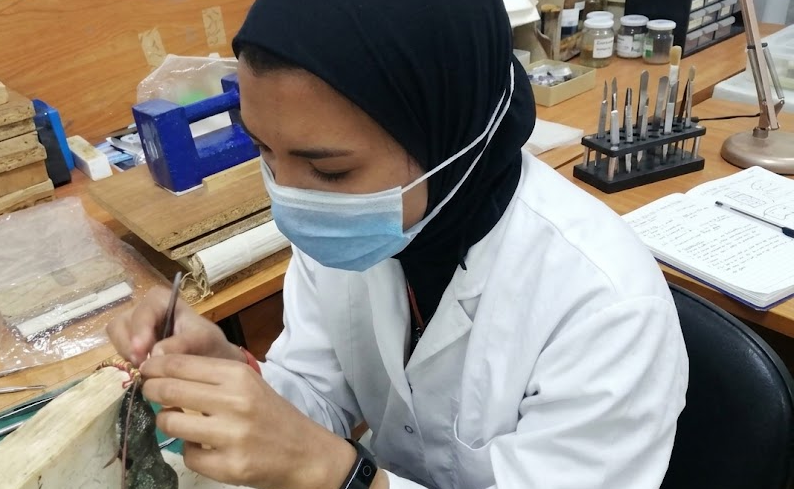
- Interviewee
- Amira Yousry · Manuscript and heritage conservator · Alexandria University, Faculty of Fine Arts
- Category
- Museos, instituciones y gestión cultural
- Published
- 2026-09-12
PO: You work at the King Abdulaziz Public Library. Could you tell us about the institution—its origins, mission, and the main types of books and documents it holds?
AY: I should note that I am no longer working at the King Abdulaziz Public Library, as I left my position there in February 2026.
The King Abdulaziz Public Library is a major Saudi cultural institution dedicated to preserving knowledge, supporting research, and promoting reading and cultural exchange. Its collections include manuscripts, rare books, historical documents, maps, photographs, and materials related to Saudi, Arab, and Islamic heritage.
During my time at the library, I worked in the Conservation and Restoration Center, where I was involved in the preservation and restoration of manuscripts, rare books, and documentary heritage collections.
PO: You are a rare books and manuscripts conservator. What kinds of items do you handle in your day-to-day work?
AY: As a conservator of rare books and manuscripts, I have worked with a wide variety of cultural heritage collections. These include manuscripts, rare books, archival documents, maps, photographs, paper-based artifacts, as well as numismatic collections such as coins and banknotes, and various types of archaeological and museum objects.
My work involves examining the condition of these materials, documenting their physical characteristics, carrying out conservation and restoration treatments when necessary, and implementing preventive conservation measures to ensure their long-term preservation. I have also been involved in preparing collection items for exhibition, storage, research access, and digitization projects.
Working with such diverse collections has provided me with experience in preserving different materials and understanding the specific conservation requirements of each type of cultural heritage object.
PO: The Arabic-speaking world played a major role in preserving and transmitting Classical knowledge. Do you work with materials related to Ancient Greece and Rome (directly or indirectly, through Arabic manuscripts and translations)?
AY: Yes. I have direct experience with this type of material. I worked on a restoration Project with the Bibliotheca Alexandrina involving Greek Orthodox manuscripts. The collection included manuscripts written in Arabic, Greek, and Latin, which gave me hands-on experience with materials connected to different cultural and linguistic traditions and to the transmission of classical knowledge.
PO: Do you also work with materials connected to Ancient Egypt or Coptic culture? If so, what kinds of documents or objects are most common?
AY: Yes. I have also worked with materials connected to Ancient Egyptian and Coptic culture. During my university studies, I had practical experience in the conservation and restoration of objects related to Egyptian heritage. I also worked on Coptic manuscripts as part of a restoration project at the Bibliotheca Alexandrina.
These experiences allowed me to work with different types of heritage materials and to understand the specific conservation challenges associated with historical manuscripts and objects from different periods.
PO: What is the strangest or most unusual book or manuscript you have ever worked on?
AY: One of the most unusual manuscripts I have worked on was a Byzantine manuscript with a wooden cover decorated with hand-painted illustrations. I have also worked with manuscripts whose covers were decorated or inlaid with precious stones, which made them particularly distinctive from a conservation perspective.
Another fascinating example was a manuscript whose cover was made from assembled leaves containing what appeared to be the advice and commandments of a priest addressed to his son. What made these objects especially interesting to me was that the historical and cultural value was not limited to the written text itself—the bindings and covers were also important historical evidence.
PO: Is the library using artificial intelligence in its workflows—especially for digitization (e.g., OCR for printed texts, or HTR for handwritten manuscripts), metadata, or search?
AY: Yes. There have been several attempts to introduce new technologies into the workflow, particularly for interpreting difficult-to-read manuscript handwriting and for scanning and analyzing watermarks. Watermark analysis can be very useful for identifying and comparing paper evidence, helping to document and date a manuscript or to confirm its attributed date.
On a personal level, I also worked on designing and developing a specialized program to calculate the area of paper loss in manuscripts. It was a very interesting and successful experience, as it allowed us to use digital tools to obtain more accurate and objective measurements during the conservation process.
PO: Are the library’s books and documents accessible online? If so, what can users consult digitally, and are there any restrictions?
AY: Yes. Both the King Abdulaziz Public Library and the Bibliotheca Alexandrina provide online access to a wide range of their digitized collections, including books, manuscripts, and documents, through their respective digital platforms.
Users can consult many of these materials digitally, although access may vary depending on copyright, intellectual property rights, and the nature of the collection. To help protect the institutions’ intellectual property and identify the source of the digital material, digitized copies may include the library’s logo or a watermark.
PO: To conclude, I’d like to ask about the new Grand Egyptian Museum near the Giza pyramids. What is your opinion of the project? Have you visited it yet?
AY: I believe the Grand Egyptian Museum is a truly world-class institution and one of the most important museum projects in the world. What makes it particularly remarkable is the extraordinary diversity of its collections, representing different periods of Egyptian history and reflecting the richness of Egypt as a land of civilizations.
Yes, I have visited the museum, and I was very impressed by its immense scale, the exceptional artifacts, the use of modern technology, and the innovative approaches to display and interpretation. I believe it represents a new and important chapter in the presentation and preservation of Egyptian heritage.
As a conservator, I would be very proud and excited to have the opportunity to work there and contribute to the preservation of these exceptional collections.
PO: Is there anything else you would like to add?
AY: I would just like to add that what I find most rewarding about conservation is the opportunity to help save an artifact and preserve it for future generations. For me, conservation is not simply about repairing an object; it is about understanding its history, respecting its original materials, and giving it the best possible chance of surviving into the future.
One of the most enjoyable parts of the work is witnessing the transformation of an artifact throughout the conservation process—from its initial condition, through examination and treatment, to its final appearance. Seeing that transformation and knowing that you have contributed to preserving a piece of history is one of the most rewarding experiences in this profession.
PO: Thank you very much for your time and kindness.