El poder de los videomappings
Albert Burzón explains the innovative Taüll 1123 videomapping project, which virtually returns the original Romanesque frescoes to the church of Sant Climent.
- Interviewee
- Albert Burzón · Explorando la intersección entre el arte y la tecnología · Burzon*Comenge
- Category
- Reconstrucción virtual e inmersión
- Published
- 2024-04-22
Interview with Albert Burzón.
Pedro Ortega: First of all, I wanted to learn about some aspects of the Taüll 1123 project, one of the most spectacular examples of videomapping applied to cultural heritage. I wanted to ask you several things—firstly, to know how and when the idea of making this videomapping arose and how the project was developed.
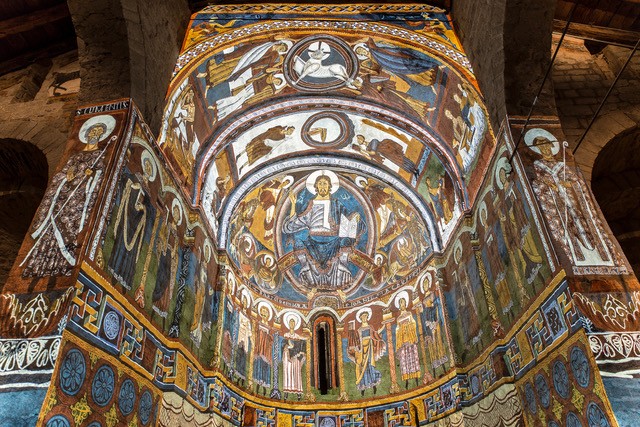
Albert Burzon: This project recreates the original frescoes that adorned the main apse and the presbytery of the central nave. These works, which date from the 12th century, are currently preserved in the Museu Nacional d’Art de Catalunya in Barcelona, known as MNAC.
For decades, the church had displayed a copy of the original paintings made on plaster; it was a work by Millet. Unfortunately, this was deteriorating over time.
In order to solve these problems, they had to remove the copy, revealing the deep layers of original painting by the Master of Taüll. An exhaustive restoration process was carried out that revealed remains of the original painting, preserved deep within the walls of the apse.
The problem was how to maintain these highly valuable original remains and dress the apse without damaging them. The experts from the Generalitat themselves believed that a projection would be the most harmless option, and that was when they consulted with several experts, including our team, Playmodes Studio and Burzon Comenge. This was back in 2010.
The main objective of this mapping project is to virtually return the original paintings to their place of origin, the church of Sant Climent de Taüll, while also seeking to reproduce the complete pictorial ensemble as it appeared in the year 1123. This audiovisual presentation not only helps visitors understand the pictorial technique used in Romanesque frescoes but also allows them to discover the diverse iconographic representations that make up this mural work, which is charged with artistic and religious meaning.
You can find more details about the project at
PO: The truth is that you were pioneers in this type of intervention. If I am not mistaken, a 3D digitalization must be planned and then interpreted to create the projection. What different softwares did you use to create the videomapping? I believe a very valuable tool is Adobe After Effects; how is this program combined with the 3D of the surface?
AB: This more technical part of the project was developed by Playmodes Studio. The process consisted of performing a laser scan of the Taüll apse and the structure where the paintings are currently located at the Museu Nacional d’Art de Catalunya. The idea was to superimpose these two realities to see how they fit. To do this, we worked with Cinema 4D, creating a virtual simulation environment to work on the placement of the different projectors and their lenses.
For the digital restoration of the paintings and the digital reconstruction of the hypothesis, we used Adobe Photoshop; this part of the project was developed by Burzon Comenge. After a study of the color and the brushwork of the paintings, we created a color palette and a collection of brushes. The animation recreating the pictorial process of the medieval mural paintings was executed with After Effects.
To fit the visual content onto the architecture through mapping engineering, we used Watchout software and Cinema 4D to create 3D animations.
PO: Things have changed from Taüll 1123 to the present; many 3D design programs have been developed and photogrammetry with drones has almost no limits. What skills must a person who wants to dedicate themselves to videomapping on cultural heritage acquire today?
AB: To dedicate oneself to videomapping on cultural heritage today, a person should acquire a variety of skills and knowledge. It is a specialty that draws from many disciplines; therefore, it is important to have the knowledge and form a team of highly specialized people. These are some of the key skills: knowledge of cultural heritage, understanding its importance and having background knowledge; digitalization techniques: photogrammetry, laser scanning, 3D software; illustration techniques to be able to restore or restitute in 2 dimensions; projection techniques, it is necessary to know the software and hardware, understand how projection technology works, calibrate projectors, and create precise mappings of three-dimensional surfaces; creativity and visual design, which involves having skills in graphic design, animation, visual composition, and visual narrative; video editing and post-production, skills in editing software such as Adobe Premiere Pro, After Effects, among others; it is also important to have research skills to deeply understand the historical and cultural context of the heritage being worked on, and being able to work in a team is fundamental.
PO: I believe you have also worked on the 3D digitalization of the churches of the Vall de Boí. How was the development of this project? Is it just photogrammetry or is there some kind of artistic intervention based on these buildings?
AB: In mid-2020, the Centre del Romànic de la Vall de Boí commissioned us to digitalize the 9 Romanesque churches of the valley, declared UNESCO World Heritage sites.
Over nine days, one per church, our team specializing in photogrammetric photography and aerial photography with drones digitalized this spectacular architectural heritage. Galo Bertran, our digitalization specialist, coordinated and executed the project.
The procedure was to take aerial photographs from early in the morning to cover the surroundings of each church, the roofs, and bell towers. Then we covered the entire exterior perimeter, photographing each church at ground level to photograph the interiors around midday. The difficulty lay in the few hours of natural light we had in the valley during the month of November, as well as the low height of the sun relative to the horizon.
Photogrammetry digitalizes an element based on triangulation and the placement of the photographs taken in a virtual space. The more information (photos) there is, the easier it is to subsequently create a digital copy of that element that is more detailed and faithful to the original.
For this reason, we took about 4000 or 5000 photos of the exterior of some churches and about 4000 more for the interior. In total, between 7000 and 9000 photos per church, depending on its size, nooks, and architectural details.
Once the capture is done, the photos are processed using Adobe Lightroom image processing software to match tones and lights and obtain quality photographic material for the next step.
Using 3D model creation software—we use Reality Capture—these images are processed to calculate a point cloud (pointcloud) and analyze if the program has correctly detected the information and the location where the photos were taken. This point cloud will later be converted into a digital mesh with the morphology of each church. This mesh is then textured using information from the photos taken.
Once the 3D master of each church is obtained, we retouch and treat it with a 3D program like Cinema 4D. In this way, we obtain the final 3D model in .fbx or .obj format to be shared on platforms like Sketchfab for the user's enjoyment.
It was truly a large-scale job that took us several months to achieve. You can see the final result at this link:
https://burzoncomenge.com/es/gallery/fotogrametria-del-conjunto-romanico-de-la-vall-de-boi/
PO: What does the Giravolt project consist of? What can you tell us about it?
AB: The Giravolt project could be explained very well by Albert Sierra, Technician of the Public Programs Area of the Agència Catalana del Patrimoni Cultural of the Generalitat de Catalunya, and Lluís González, Technician of the Architectural Heritage Service of the Direcció General del Patrimoni Cultural of the Generalitat de Catalunya.
In January 2020, Giravolt was officially launched, a program aimed at promoting the use of 3D technologies in the field of cultural heritage in Catalonia. This initiative arises from a collaboration between the Agència and the Direcció General del Patrimoni Cultural, following an analysis carried out in 2018 that identified the growing impact of 3D technologies in various sectors. The program aims to encourage the adoption of these technologies in the heritage sector, increase understanding of their utility in all stages of the work process, and promote their autonomous application by managers and institutions in the coming years. The program is structured into four main areas: creation and maintenance of a digital archive, connection with the professional sector, link with the educational sector, and dissemination to different audiences.
The Agency hired our services to produce an audiovisual to present and promote the project; it is an immersive experience playing with the duality of form and its abstraction at the moment we apply technology. Its script is based on concepts such as geometry, matter, construction, deconstruction, materials, and textures; but we also work with emotion and the magic of how to make a journey to the future with elements from the past.
You can find more details about the project at https://burzoncomenge.com/es/gallery/giravolt/
PO: Have you also created virtual tours, as is the case with the Diocesan Museum of Tarragona?
AB: The virtual visit of the Diocesan Museum of Tarragona was one of the first tours we carried out, around 2019. The challenge was to cover the vast territory occupied by this museum located inside the Cathedral of Tarragona, especially with the added difficulty of capturing the large central cloister in daylight without the daytime infrared light affecting the 3D sensor that allows making a 3D model while photographing the space with 360 photos. The result of the 3D "dollhouse" at the start of the visit is impressive, then moving into first-person mode to start the visit.
The museum was open to the public, making the capture difficult and often slowing it down while waiting for an area to clear. It took a total of two days to capture all the spaces of the museum and then approximately one week to edit all the content of the exhibited works, the added photos, etc. We even added a 3D model to be able to visualize in detail the curious capital of "the procession of the rats," sculpted on one of the columns of the cloister.
Since then, we have carried out other virtual tours such as the one for Palau Moja, a beautiful palace in Barcelona that houses the offices of the Catalan Agency of Cultural Heritage, or the headquarters of the Center for Restoration of Movable Goods of Catalonia, among others. In this last tour, it is interesting because the professional restorers appear digitalized in 3D while doing their work in situ.
You can find more details about the project at https://burzoncomenge.com/es/gallery/museu-diocesa-de-tarragona-tour-virtual/
PO: What other type of creative projects linked to cultural heritage are you developing at Burzon-Comenge?
AB: Currently, we are involved in several projects, although we cannot reveal specific details at this time. However, we can offer an overview of our activities. The most prominent project involves creating an immersive experience focused on five monuments of Catalan heritage. To achieve this, we are reconstructing and recreating these monuments, or parts of them, in 3D using video game engine software. Additionally, we are developing several audiovisuals that include 3D content and animation, as well as artificial intelligence technology for implementation in immersive rooms. Parallel to this, we have been dedicating months to the digital restoration and recreation of some well-known and spectacular Baroque paintings.
PO: To finish the interview, I wanted to ask you about a personal aspiration because I want to know your opinion. I would like to launch a metaverse for cultural heritage that is free to access. How do you see this idea from your point of view? What would be the first steps to take according to your criteria? What could Burzon-Comenge contribute to this project?
AB: The idea of creating a metaverse for cultural heritage with free access is very promising. From my point of view, it represents an innovative way to preserve and disseminate cultural heritage in an accessible and attractive way to expand audiences. Firstly, it would be important to clearly define the objectives of the project.
The next steps would involve research and analysis. Working in collaboration with specialists such as historians or archaeologists, an initial technical script would be prepared, which would later be developed into a literary script. This script would serve as the basis for identifying the necessary digitalizations or reconstructions, and from there, the production phase would begin.
Burzon Comenge can contribute to this project by providing its creative vision and experience in digital strategy. Our services cover all aspects of these types of projects, from defining objectives to design, production, and installation control.
PO: Would you like to add anything else?
AB: Technology applied to cultural heritage represents a significant advance in the preservation, dissemination, and accessibility of our cultural legacies. However, it is essential to understand that technology in itself is only a medium, a channel, a tool to achieve certain heritage-related objectives, and should never come before the content. In this sense, a solid content strategy is fundamental in projects involving technology and cultural heritage.
PO: Thank you very much for your collaboration.